Seating
- Hits: 13
Scandinavian design in the contract market operates by a different logic than Italian or German design. While the Italian industry runs on designer authorship and the editor model and the German on system engineering, the Scandinavian tradition is craft-based, reductionist and socially democratic at its core — furniture as well-made everyday objects rather than sculptural icons. This stance shapes both the material DNA (light woods, wool, felt, steel) and the tendering logic: Scandinavian manufacturers typically supply entire areas, not individual statement pieces, and are often specified as volume suppliers with a design claim rather than as identity anchors.
The industry is distributed across four countries with distinct profiles: Denmark as heritage editor country with Fritz Hansen, Carl Hansen & Søn, HAY and Muuto; Sweden as workplace heavyweight with Kinnarps, Lammhults and the Swedish-led Möbelfakta certification; Norway as home of the only Nordic workplace group Flokk, which holds HÅG, RH, Profim and Offecct under one roof; Finland with the Aalto tradition through Artek, the full-service workplace tradition through Isku and Martela, and the glass and textile heritage through Iittala and Marimekko. Independent structures dominate internationally — unlike Italy, there is barely any PE-led consolidation, with the exception of Flokk and individual MillerKnoll acquisitions like HAY (2018) and Muuto (2017).
Scandinavian design is not a protected term but a stylistic attribution that formed between the 1930s and 1960s — fed by the Finnish functionalism tradition of Alvar Aalto, the Danish modernism of Arne Jacobsen, Hans Wegner and Finn Juhl, and the Swedish Werkbund-adjacent tradition around Bruno Mathsson and Carl Malmsten. The cultural anchor was the touring exhibition "Design in Scandinavia", which moved through twenty-two North American museums between 1954 and 1957 and established the term internationally. What distinguishes the Scandinavian term from Italian or German design: Scandinavian design is not primarily author- or engineer-driven but grew out of an egalitarian design stance — good form for all, sound in craft, true to material, and built to last.
In everyday usage, "Scandinavian" and "Nordic" are often used synonymously, although they are defined differently in geographic terms: Scandinavia, strictly speaking, refers to Denmark, Sweden and Norway only; the Nordic region additionally includes Finland and Iceland. In the furniture context, both regions have pragmatically been treated as a shared design culture — not least because Artek, Nikari and Iittala from Finland are inseparable from design history, as are the Swedish-Finnish workplace manufacturers Martela and Isku. For day-to-day specifier work this means: a project search for Scandinavian design typically includes Finnish brands, whereas a search for Danish or Swedish design draws a tighter boundary.
The four countries bring different design traditions and market structures to the table. Denmark is the internationally most visible heritage editor country — Copenhagen, Aarhus and Odense form the geographic core, with Fritz Hansen (Allerød), Carl Hansen & Søn (Gelsted/Aarhus), Fredericia (Fredericia), HAY (Horsens), Muuto, GUBI, &Tradition and Montana as defining brands. Sweden is the workplace heavyweight with volume-capable industrial producers — Kinnarps (Kinnarp), Lammhults (Lammhult) and Offecct (Tibro) serve the project market, while Fogia, Asplund and Blå Station hold the premium segment.
Norway is the smallest market by volume but hosts the only major Nordic workplace group: Flokk, based in Oslo, holds the brands HÅG, RH, Profim, Offecct, Edsbyn, BMA and Giroflex under one roof and has been under the PE investor Triton Partners since 2018 — structurally the only Scandinavian counterpart to the Italian corporate groups like Haworth Lifestyle or the Flos B&B Italia Group. Finland brings two distinct traditions: the Aalto line with Artek (today owned by Vitra) and Nikari as a craft-oriented workshop, and the volume-capable full-service workplace suppliers Isku and Martela, active across Europe in workplace and education projects. Iittala, Marimekko and the Finnish lighting tradition round out the picture, though more strongly in tabletop and textiles than in the core furniture segment.
Three European design traditions shape the contract market — and they differ structurally. Italian design is author-driven and sculptural, with the Salone del Mobile as its central identity anchor and corporate groups like Haworth Lifestyle, the Flos B&B Italia Group or Dexelance as the defining ownership structure. German design is engineering-driven and system-oriented — manufacturers like Wilkhahn, Sedus or Vitsœ develop from ergonomic standards and system logic.
Scandinavian design stands at an angle to both: craft-based and reductionist rather than sculptural or engineering-driven, material-true rather than representative. In day-to-day specifier work this means Scandinavian furniture is usually not placed as statement pieces but tendered as a furnishing baseline — the chair family for the entire conference area, the sofa system for the lounge, the table for the cafeteria. Where the Italian editor calculates the single object with designer royalty and the German office manufacturer prepares a system calculation across 500 workstations, the Scandinavian supplier calculates serial production with egalitarian design quality — typically in the mid-to-upper price segment, with reliable delivery logistics and a pronounced appreciation of sustainable material practices.
The material palette of Scandinavian furniture manufacturers follows the availability of Nordic forests and a craft-grown wood tradition. Light solid woods dominate: oak, beech, birch, ash and pine from FSC- or PEFC-certified forestry are standard, often combined with natural oils or water-based lacquer rather than synthetic coatings. Carl Hansen & Søn sources the wood for the Wegner Wishbone Chair series exclusively from European forests and works with paper-cord seats that are hand-knotted in over 100 working steps per chair. Fredericia, &Tradition and Nikari work in the same craft tradition, often with small workshop structures that move between industrial and bench-made production.
Upholstery and textiles are the second pillar. Scandinavian manufacturers work disproportionately often with Nordic textile suppliers — Kvadrat from Denmark is the dominant fabric partner for premium brands, alongside Gabriel (DK), Sahco and Sandatex. Wool, felt, linen and recycled synthetics shape the upholstery offering; elaborate leather work as in Italy is less common but appears at heritage brands like Fritz Hansen (Egg Chair, Swan Chair) and Carl Hansen & Søn. Steel and aluminium tubing complement the material range at workplace suppliers like Kinnarps, Lammhults and Flokk. Marble and bronze, standard in Italian premium lines, are largely absent — a deliberate material restraint that reinforces the egalitarian design stance.
Scandinavian furniture for the contract market meets the European standards for office swivel chairs (EN 1335), conference and visitor chairs (EN 16139) and upholstered seating in object environments (EN 1021-1 and EN 1021-2 for cigarette and match ignitability). For hospitality projects with higher requirements, most manufacturers meet Crib 5 (BS 5852) — relevant for hotels, theatres and public assembly venues. Greenguard and Indoor Air Comfort certifications for VOC emissions are standard at the premium end.
The distinctively Nordic contribution to the spec world is Möbelfakta — a three-pillar label founded in 1972 by the Swedish furniture industry and today administered by Trä- och Möbelföretagen (TMF), which certifies furniture according to quality (testing per EN standards), social responsibility (supply-chain audits per SA 8000) and environmental impact (material origin, recyclability, chemicals). Unlike Italian brands, whose supply chains are often documented project by project, specifiers working with Möbelfakta-certified suppliers can rely on a standardised data foundation. Kinnarps, Lammhults, Martela, Offecct, Flokk and Glimakra of Sweden hold Möbelfakta certifications for relevant parts of their range, which structurally advantages Nordic suppliers in EU-wide public tendering — especially in calls with sustainability criteria.
Tendering Scandinavian furniture works differently than with Italian brands: instead of individual statement pieces with designer royalty, projects are typically tendered in series — a chair family for the entire conference area, a modular sofa system for the lounge, a table system for the cafeteria. The largest manufacturers operate dedicated contract units: Fritz Hansen Project and Carl Hansen & Søn Contract deliver adjusted upholstery, more robust padding and project-specific dimensions on the heritage pieces (Jacobsen Egg Chair, Wegner Wishbone). Licence fees to designer estates (Jacobsen, Wegner, Aalto, Verner Panton) flow per unit produced and are included in the specifier price — structurally comparable to the Italian editor model, though typically with lower royalty shares because the heritage lines are older and therefore less expensive in licence terms.
In the workplace segment, Kinnarps, Martela, Isku and the brands of the Flokk group (HÅG, RH, Profim, Offecct, Edsbyn) deliver complete office systems including acoustics, partitions and storage. These suppliers operate with their own logistics and service structures in DACH and Europe and are often listed as approved suppliers in framework agreements of large corporations. For mid-volume hospitality projects, Muuto, HAY, Fredericia and GUBI dominate — the lines are calculable, with EU-compliant logistics and volume discounts from 50 to 100 units upwards. Industry associations like TMF (Sweden), Dansk Industri Møbler (Denmark) and Suomen Huonekalualan Liitto (Finland) provide market data and standard clauses; the leading trade fairs for the workplace and hospitality sectors are Stockholm Furniture & Light Fair (February) and 3 Days of Design Copenhagen (June), supplemented by Habitare in Helsinki (September).
Unlike the Italian furniture industry, where five corporate groups have dominated the premium market since the 2010s, the Scandinavian industry remains predominantly family- and independent-led. Most heritage brands are still in founder-family or foundation ownership: Carl Hansen & Søn is run in the fourth generation, Fredericia has been owned by the Andersen family since the 1950s, Kinnarps has been in the Andersson family since 1942. Fritz Hansen has operated under changing ownership structures since the 1970s but is today part of Republic of Fritz Hansen, which acts as an independent operating entity.
Four consolidation stories nevertheless shape the picture. Flokk from Oslo, under PE investor Triton Partners since 2018, is the only genuinely Nordic workplace holding with a substantial portfolio — the group brings together HÅG, RH, Profim, Offecct, Edsbyn, BMA and Giroflex under one roof and is approaching 500 million euros in revenue. The US group MillerKnoll acquired two Danish brands in the late 2010s — Muuto (2017) and HAY (2018) — and runs them as independent brands within the global MillerKnoll family. The Finnish Fiskars Group holds the tabletop and glass brands Iittala, Royal Copenhagen and Wedgwood as a heritage portfolio but does not operate in the core furniture market. And the Italian Flos B&B Italia Group holds two Danish brands with Louis Poulsen and Audo Copenhagen — a notable case of non-Nordic capital reaching into the Nordic design industry.
For the specifier, the structural takeaway remains: anyone working with Scandinavian brands negotiates predominantly with family- or founder-led structures — direct decision paths, long-term business relationships, less corporate logic. Only in the workplace segment around Flokk and at the MillerKnoll-owned HAY and Muuto do corporate cross-selling mechanisms come into play. Compared with the Italian consolidation phase, which has reached an endgame, the Scandinavian industry is structurally younger and more agile — which suits specifiers who value direct contact with designers and plant management.
Unlike the Italian industry, which relies on the Salone del Mobile as its central identity anchor, Scandinavian trade fair activity is distributed across three cities with distinct profiles. The Stockholm Furniture & Light Fair has been the largest B2B fair in the region since 1951 and takes place every February at Stockholmsmässan — traditionally the specifier event for Nordic workplace and hospitality manufacturers. After years of declining exhibitor and visitor numbers, a complete cancellation in 2025 and a takeover by RX Sweden, the fair re-launched in 2026 under the new Stockholm Furniture & Light Fair branding — smaller than in the 2010s but strategically focused on workplace, hospitality and lighting.
3 Days of Design in Copenhagen is the counter-model to the classical trade fair: a decentralised showroom festival that takes place every June, with over 400 brands (as of 2025) exhibiting in their own spaces, galleries and temporary locations. The format has grown over the last ten years from a Danish brand initiative to an international pilgrimage destination for specifiers and design journalists — Brera logic in a Scandinavian register, without a central exhibition hall. Fritz Hansen, Carl Hansen & Søn, HAY, Muuto, GUBI, &Tradition, Fredericia and Montana use the format as their central annual stage.
Habitare in Helsinki, held every September at Messukeskus, is the Finnish industry fair with a distinctly national focus. Less relevant for international specifiers than Stockholm or Copenhagen, but central for the Finnish workplace suppliers Martela, Isku, Inno and Piiroinen. In sum, this means for the Scandinavian industry: anyone who wants to understand the market as a specifier combines Stockholm in February (workplace spec) with Copenhagen in June (editor brands, hospitality, design journalism) — and adds Helsinki in September for Finnish project work.
The Scandinavian furniture industry enjoys a structural lead in sustainability spec, built on two factors: FSC- and PEFC-certified forestry, which is established as a standard across the four countries, and the Möbelfakta label, which has provided standardised material and supply-chain data for over fifty years. As a result, many Scandinavian manufacturers are technically better prepared for the EU Digital Product Passport (DPP) than their Italian or German competitors — the underlying data on material origin, recyclability and chemical composition is already documented.
The DPP is prioritised for furniture under EU regulation ESPR in the Working Plan 2025–2030: full ESPR application begins on 19 July 2026 with the go-live of the EU Central DPP Registry, the product-specific delegated act for furniture is expected in 2027 to 2028, mandatory furniture DPPs come into force after an 18-month compliance window, so realistically from 2029. Kinnarps introduced its own sustainability programme, "The Better Effect Index", as early as 2014, aggregating material and social data per product; Flokk has been publishing Environmental Product Declarations (EPDs) for its entire range since 2010, in line with ISO 14025; Lammhults has been working on a cradle-to-cradle roadmap since 2022. For specifiers this means: those who source Scandinavian brands in EU-certified projects can rely on a comparatively mature data foundation — and reduce the compliance risk relative to industries with weaker documentation.
The internationally defining brands of Scandinavian design are seven houses that have turned the heritage editor model into a global signature. Fritz Hansen from Allerød holds the rights to the classics by Arne Jacobsen (Egg, Swan, Series 7), Poul Kjærholm and Piet Hein and remains, through Fritz Hansen Project, the central reference for Danish design history within an active programme. Carl Hansen & Søn from Gelsted and Aarhus, run in the fourth generation by the founding family, is the licence holder of the Hans Wegner heritage (Wishbone Chair, CH series) and the most important representative of craft-based wood manufacturing. HAY from Horsens, part of MillerKnoll since 2018, combines Nordic restraint with accessible price points and has, over the 2010s, established itself as a broadly specified brand for workplace and hospitality projects. Muuto from Copenhagen, also under MillerKnoll (since 2017), operates in the same segment with a more contemporary design signature. &Tradition from Copenhagen, independent under Martin Kornbek Hansen, brings together re-editions of Verner Panton, Arne Jacobsen and Jaime Hayon with contemporary designers like Sebastian Herkner and Space Copenhagen. GUBI from Copenhagen is the heritage editor with a focus on forgotten classics (Gio Ponti, Mathieu Matégot) and contemporary work by GamFratesi. Artek from Helsinki, owned by Vitra since 2013, holds the Alvar Aalto heritage and has produced the Stool 60, the Aalto armchair and the side tables in unbroken continuity since 1935.
Behind the top tier sits a dense layer of premium brands with heritage character and predominantly family or foundation ownership. Fredericia, owned by the Andersen family since 1955 and equipped with the Børge Mogensen heritage, is structurally the most important Danish heritage brand below the D1 top tier. Montana from Haarby is the Danish counterpart to Switzerland's USM Haller — a modular storage system in 42 colours, produced since 1982. Karakter from Copenhagen, part of Haworth Lifestyle, operates as a curated editorial label with designers like Aldo Bakker and Léon Ransmeier. Paustian, Hans Hansen, Friends & Founders, Kristina Dam Studio, 101 Copenhagen, AYTM, Form & Refine and NORR11 serve the younger generation of Danish premium brands with distinct design signatures, often with workshop production and tightly curated ranges.
In Sweden, the premium segment is held by Asplund, Fogia, Karl Andersson, Mizetto, Johanson Design, Ragnars and Nola Industrier, complemented by the bed-heritage house Hästens. Reform is a Danish specialist for designer kitchen fronts on IKEA carcasses, positioned as a crossover between furniture and kitchen. Sika Design carries the Danish wickerwork heritage forward as a specialised heritage producer.
Where the global design houses and premium family-owned brands carry the heritage editor model, the Scandinavian contract and workplace specialists operate in a more serial and volume-oriented mode. Kinnarps from Kinnarp, with around 2,500 employees and proprietary logistics in 40 countries, is the largest Scandinavian workplace full-service supplier — furniture, acoustics, partitions, storage, all from one source, with the Better Effect Index as an integrated sustainability reporting framework. Martela from Helsinki and Isku from Lahti are the Finnish counterparts — both publicly listed, both with strong education and workplace divisions. Lammhults from Lammhult covers the interface between workplace and hospitality.
The Flokk group from Oslo is the only Nordic workplace holding and the actual consolidation special case: HÅG (ergonomics), RH (premium office chairs), Profim (soft seating, Polish subsidiary), Offecct (acoustic solutions, Swedish), Edsbyn (workplace, Swedish), BMA (Netherlands) and Giroflex (Switzerland). Profim and Offecct are listed separately in the furnomics directory — specifiers should know that both brands belong to the Flokk family and can often be negotiated jointly in framework agreements. Glimakra of Sweden, Blå Station, Fora Form and Howe complement the workplace spectrum with smaller, specialised ranges.
In international workplace tendering a clearly identifiable cluster of Scandinavian office furniture brands has emerged — Kinnarps, Martela, Isku and Lammhults as full-service suppliers; the Flokk brands as a modular chair and soft-seating cluster; Green Furniture Concept and Götessons as acoustic and lounge specialists. For DACH and European specifiers, this cluster delivers the fastest logistics and compliance performance in projects with sustainability tendering criteria.
The Scandinavian lighting industry is closely interwoven with the furniture industry — many of the defining designers worked across both fields. Louis Poulsen from Copenhagen, founded in 1874 and part of the Italian Flos B&B Italia Group since 2018, dominates the architectural premium segment with the PH lamps by Poul Henningsen, the AJ lamps by Arne Jacobsen and the Patera pendants by Øivind Slaatto. Despite its Italian ownership, Louis Poulsen remains anchored in Vejen (Denmark) for production and is still regarded as the central Scandinavian lighting brand. Le Klint from Odense is the Danish specialist for hand-folded shades in paper and plastic, family-owned in the fourth generation since 1943.
From Finland, Iittala and Marimekko bring the glass and textile tradition into the specifier context: Iittala (Fiskars Group) supplies the Aalto vases, glass carafes and tableware lines that are standard in Scandinavian-leaning hospitality projects. Marimekko (publicly listed) is present in branded residences and hotel lobbies with the large-format Unikko patterns and the textile collection. Secto Design from Heinola produces wood lamps in birch-veneer slat construction, often specified in hospitality and residential projects. Audo Copenhagen (formerly Menu, part of the Flos B&B Italia Group since 2024) combines lighting with furniture and accessories under a single brand. Wästberg from Helsingborg is the Swedish architectural lighting specialist with designers like Ilse Crawford and David Chipperfield.
Beyond the brands presented here, the furnomics brand directory documents the full breadth of the Scandinavian furniture and lighting market — from heritage upholstery makers like Hästens through younger Danish editorial brands like NORR11, AYTM and Friends & Founders to specialised suppliers for acoustics, outdoor and components like Green Furniture Concept, Nola Industrier and Sika Design. Structural independence remains characteristic of the Scandinavian market: a small number of internationally visible brands is followed by a broad layer of family- and workshop-led suppliers whose visibility runs primarily through showroom structures, specifier platforms and the 3 Days of Design network in Copenhagen.
Scandinavian design is craft-based and reductionist at its core, with an egalitarian grounding; Italian design is author-driven and sculptural; German design is engineering-driven and system-oriented. In day-to-day specifier work this means Scandinavian furniture is usually tendered as a furnishing baseline — a chair system for the entire conference area, a sofa programme for the lounge — while Italian brands like Cassina or Minotti are placed as statement pieces and German manufacturers like Wilkhahn or Sedus deliver the system architecture in workplace projects.
Geographically, Scandinavia strictly refers to Denmark, Sweden and Norway only, while the Nordic region additionally includes Finland and Iceland. In the furniture context the two terms are mostly used synonymously, because Finnish brands like Artek, Nikari, Iittala, Marimekko, Martela and Isku are inseparable from the shared design tradition. Pragmatically: a specifier search for Scandinavian design typically includes Finnish brands, whereas a search for Danish or Swedish design draws a tighter boundary.
For hospitality and premium residential, Fritz Hansen Project, Carl Hansen & Søn Contract, HAY, Muuto, &Tradition, Fredericia, GUBI and Montana dominate the upper segment. In the workplace space, Kinnarps, Martela, Isku and the brands of the Flokk group (HÅG, RH, Profim, Offecct, Edsbyn) are the structurally most viable suppliers with proprietary logistics and service structures in DACH and across Europe. For acoustic and lounge elements, Glimakra of Sweden, Blå Station, Green Furniture Concept and Götessons provide the complementary specialty lines.
In international workplace tendering a clearly identifiable Scandinavian cluster has emerged: Kinnarps, Martela and Isku as full-service suppliers with complete office systems including acoustics and partitions; the Flokk group (HÅG, RH, Profim, Offecct, Edsbyn) as a modular chair and soft-seating cluster with aluminium- and steel-based industrial production; Lammhults as an interface between workplace and hospitality; Glimakra of Sweden, Blå Station and Green Furniture Concept as acoustic and lounge specialists. The cluster combines design credentials with EU-compliant logistics, Möbelfakta certification and predictable lead times — the realistic answer for international workplace projects looking for a Nordic spec source.
Three factors drive the price: licence fees to designer estates for heritage pieces such as the Wegner Wishbone Chair at Carl Hansen & Søn or the Jacobsen Egg Chair at Fritz Hansen; craft-based manufacturing depth with FSC-certified solid wood and multi-step surface treatments; and Nordic production locations with higher labour costs than Asian or Southern European competitors. For the Wishbone Chair, royalties flow per unit to the Wegner heirs, and the paper-cord seat is hand-knotted in over 100 working steps per chair — which raises the price considerably above functionally comparable, industrially produced wooden chairs without authorship.
Möbelfakta is a three-pillar label, founded in 1972 by the Swedish furniture industry and today administered by Trä- och Möbelföretagen (TMF), which certifies furniture according to quality (EN standards), social responsibility (supply-chain audits per SA 8000) and environmental impact (material origin, recyclability, chemicals). Unlike Italian brands, whose supply chains are often documented project by project, specifiers working with Möbelfakta-certified suppliers can rely on a standardised data foundation. This structurally advantages Scandinavian manufacturers like Kinnarps, Lammhults, Martela, Offecct, Flokk and Glimakra of Sweden in EU-wide public tendering — especially in calls with sustainability criteria.
Unlike the Italian furniture industry, where five corporate groups have dominated the premium market since the 2010s, the Scandinavian industry remains predominantly family- and independent-led. Four consolidation stories nevertheless shape the picture: the Norwegian Flokk group has been under PE investor Triton Partners since 2018 and holds HÅG, RH, Profim, Offecct, Edsbyn, BMA and Giroflex. The US group MillerKnoll acquired Muuto in 2017 and HAY in 2018. The Finnish Fiskars Group holds Iittala, Royal Copenhagen and Wedgwood in the tabletop area. And the Italian Flos B&B Italia Group holds two Danish brands with Louis Poulsen and Audo Copenhagen. Most heritage brands remain in founder-family or foundation ownership — Carl Hansen & Søn in the fourth generation, Fredericia in the Andersen family, Kinnarps in the Andersson family.
The Digital Product Passport (DPP) is being phased in for furniture under EU regulation ESPR in the Working Plan 2025–2030, with full ESPR application starting on 19 July 2026 and a product-specific delegated act expected in 2027 to 2028. Mandatory furniture DPPs come into force, after an 18-month compliance window, in 2029 at the earliest. Scandinavian manufacturers have a structural lead because FSC and PEFC certifications, Möbelfakta data and Environmental Product Declarations (EPDs) have been established at many suppliers for years. Kinnarps has run its Better Effect Index reporting since 2014, Flokk has been publishing EPDs per ISO 14025 since 2010, Lammhults has been working on a cradle-to-cradle roadmap since 2022. For specifiers, the compliance risk is reduced compared with industries that have weaker documentation foundations.
Unlike the Italian industry, which relies on the Salone del Mobile as its central identity anchor, Scandinavian trade fair activity is distributed across three cities. Stockholm Furniture & Light Fair (annual, February, since 1951) is the traditional B2B fair in the region, re-launched in 2026 under RX Sweden with a focused workplace and hospitality emphasis. 3 Days of Design (annual, June, Copenhagen) is the showroom festival with over 400 participating brands and has, over the last ten years, become the international specifier address — Brera logic in a Scandinavian register. Habitare (annual, September, Helsinki) is the Finnish industry fair with a national focus, central for Martela, Isku, Inno and Piiroinen. A specifier who wants to understand the market thoroughly combines Stockholm (workplace), Copenhagen (editorial and hospitality) and Helsinki (Finnish project work).
Scandinavian design is part of a wider fabric of design cultures, sectors and market platforms that overlap in contract work. The following topics either complement or delimit the Scandinavian hub.
Read more …Scandinavian design: manufacturers in the contract market
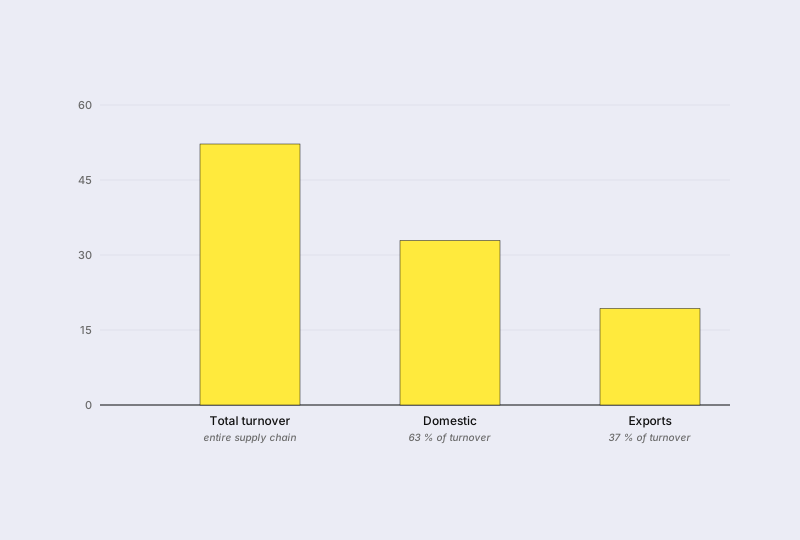
Italian design in the contract market operates by a logic of its own, clearly distinct from German engineering tradition and Scandinavian reductionism. The Italian furniture industry has worked under the editor model since the 1950s — manufacturers like Cassina and Kartell license designs from external authors rather than building in-house teams. The result is a portfolio that resembles a gallery more than a product line: curated, author-driven, with high recognisability per object. For architects and interior designers this means Italian brands are specified less through system logic than through individual icons meant to define a project.
The manufacturer landscape concentrates geographically in three clusters: the Brianza area north of Milan with Cassina, Molteni&C, Poliform and B&B Italia; the Apulian upholstery district led by Natuzzi; and the Milan Design District as the central showroom and Salone stage. Smaller districts add to the picture: Friuli with Calligaris as chair specialist, Le Marche with Poltrona Frau as leather pioneer in Tolentino, and the Veneto with workplace and hospitality brands like Arper and Magis. International ownership is dominated by a small number of corporate groups — Haworth Lifestyle holds Cassina, Poltrona Frau and Cappellini; Flos B&B Italia Group bundles B&B Italia, Maxalto and Flos; Molteni Group operates independently with Molteni&C and UniFor.
In furniture, "Italian design" is not a protected term but a stylistic attribution that emerged in the 1950s and 1960s — as Achille Castiglioni, Gio Ponti, Vico Magistretti and later Ettore Sottsass shaped the genre. The cultural frame was, from the beginning, the Salone del Mobile, which has taken place annually in Milan since 1961 and has become the global trade fair for high-quality furniture. What distinguishes the Italian term from its German or Scandinavian counterparts: Italian design is not primarily justified by function or reduction but is author-driven, often sculptural, and emotionally charged.
For the contract sector this creates an asymmetry between perception and spec reality. Brands like Cassina, B&B Italia or Poltrona Frau appear in architects' practices more prominently than their actual share of the project business would suggest — many projects specify a single Italian lounge piece as an identity anchor and source the bulk of the furnishing from workplace or hospitality specialists of other origin.
Italian furniture production concentrates in a handful of districts, each with its own specialisation. The Brianza between Milan and Como is the industrial heart — home to Cassina (Meda), Molteni&C (Giussano), Poliform (Inverigo), B&B Italia (Novedrate), Flexform (Meda), Minotti (Meda) and Porro (Montesolaro di Carimate). In the Veneto, hospitality- and workplace-specialised manufacturers cluster — Arper (Monastier di Treviso), Magis (Torre di Mosto), Frezza and Quadrifoglio Group, with Pedrali in neighbouring Mornico al Serio (Bergamo, Lombardy) extending the cluster at its western edge. Friuli, with Calligaris (Manzano) and a string of smaller specialists, hosts the historic chair district around Manzano. The leather upholstery tradition splits across two regions: Le Marche with Poltrona Frau (Tolentino) and the Apulian Murge area around Santeramo in Colle with Natuzzi at its head.
This geographic concentration has structural consequences. Family ownership has dominated historically; consolidation has unfolded since the 2010s through international investors — Haworth acquired the Poltrona Frau Group in 2014, taking on Cassina and Cappellini as well; Investindustrial and Carlyle Group founded today's Flos B&B Italia Group in 2018; Alpha Private Equity formed Orbital Design Collective out of the Calligaris Group. Milan itself produces little but functions as a showroom city: Brera, Durini, Tortona and 5VIE are the districts where manufacturers and designers present themselves to the international specifier community.
Three European design traditions shape the contract market — and they differ structurally. German design operates from engineering: manufacturers like Wilkhahn, Sedus or Vitsœ develop from function, ergonomic standards and system logic. Scandinavian design moves between democratisation and reduction — Fritz Hansen, Carl Hansen & Søn or Muuto combine craft tradition with accessible formal language.
Italian design stands sideways to both: author-driven rather than system-driven, sculptural rather than reduced, representative rather than egalitarian. In day-to-day specifier work this means Italian furniture is rarely tendered as a furnishing system but placed as statement pieces — the lounge in reception, the conference armchair in the boardroom, the sofa in the brand space. For tendering logic the distinction matters: where the German office manufacturer prepares a system calculation across 500 workstations, the Italian editor calculates the single object with designer royalty.

The material palette of Italian furniture manufacturers follows historically grown district specialisations. Upholstery and leather dominate at Poltrona Frau, Natuzzi, Baxter and Flexform — Poltrona Frau alone processes around 600,000 square metres of leather per year at its Tolentino plant, primarily its proprietary Pelle Frau in 96 shades. Wood processing in Brianza is the second pillar: Molteni&C, Cassina, Poliform and Porro work with veneer techniques that move between industrial production and workshop craft. Marble and natural stone arrive through brands like Edra and Giorgetti for their premium lines, often in combination with bronze or brass detailing.
Polypropylene and technical plastics have belonged to the Italian DNA since the 1960s — Kartell established the material in furniture, Magis and Pedrali developed it further for the contract market. Cast aluminium and bent steel tube appear at Arper, Pedrali and Calligaris, often paired with recycled upholstery fabrics. Manufacturing tolerances at the premium end approach those of the joinery workshop — visible seam guidance on leather upholstery and veneer alignment on table tops are expected from the specifier sample, not renegotiated later.
Italian furniture for the contract market meets the European standards for office swivel chairs (EN 1335), conference and visitor chairs (EN 16139) and upholstered seating in object environments (EN 1021-1 and EN 1021-2 for cigarette and match ignitability). For hospitality projects with higher requirements most manufacturers meet Crib 5 (BS 5852) or the Italian classes 1IM and 1 under UNI 9175 — relevant for hotels, theatres and public assembly venues. Pedrali, Arper and Magis additionally hold Greenguard certifications for VOC emissions, required in North American and LEED-certified projects.
The REACH regulation and the formaldehyde limit of 0.062 mg/m³ tightened at the end of 2026 affect the Italian industry unevenly — high-volume manufacturers with industrial production are better prepared than the small edition workshops, whose supply chains are often documented only project by project. The Digital Product Passport (DPP) is prioritised for furniture in the ESPR Working Plan 2025–2030; full ESPR application begins on 19 July 2026, the product-specific delegated act for furniture is expected in 2027 to 2028, mandatory furniture DPPs follow after an 18-month compliance window, so realistically from 2029. Cassina and Molteni&C have built their own material databases for this purpose; many premium family-owned brands are still at the beginning. For the specifier this means supplier audits belong in the premium project workflow with Italian brands, not at the tendering stage.
Tendering Italian furniture rarely follows the high-volume grid of other European markets. The largest manufacturers operate dedicated contract units that adapt standard collections for project work — B&B Italia Project, Cassina Contract and Molteni Contract are the best known. These divisions deliver adjusted upholstery, more robust padding and project-specific dimensions while preserving the original design. Licence fees to designer estates (Le Corbusier, Mies van der Rohe, Castiglioni heirs) flow per unit produced and are included in the specifier price — making re-editions from the Cassina catalogue significantly more expensive than functionally comparable pieces without authorship.
In the workplace segment, UniFor (Molteni&C's sister company, with Citterio partitions) and Estel Group deliver complete office systems including partitions and acoustic solutions. For medium-volume hospitality and mixed-use projects, an Italian office furniture cluster has consolidated around Pedrali, Calligaris, Quadrifoglio Group, Frezza and Kastel — calculable lines with volume discounts and EU-compliant logistics. Industry associations like FederlegnoArredo and Assufficio provide market data and standard clauses; the trade fair for the workplace sector is Workplace3.0 as a Salone sub-format.

The family-business structure that shaped Italian furniture design for decades has given way, since the mid-2010s, to consolidation by international investors. Five groups dominate today's premium market. Haworth Lifestyle, the furniture federation of the US group Haworth Inc., holds Cassina, Poltrona Frau, Cappellini, Zanotta (acquired in 2023 via Cassina), Ceccotti and Karakter, along with the retail and licensing arms Luxury Living Group (with Fendi Casa, Bentley Home, Bugatti Home), JANUS et Cie, Luminaire and Interni. The group is approaching one billion euros in revenue and was reorganised in 2025 into four operating divisions (Luxury, Design, Industrial, Retail).
Flos B&B Italia Group — operating as Design Holding until May 2024, founded in 2018 as a joint venture between Investindustrial and the Carlyle Group — bundles B&B Italia, Maxalto, Arclinea, Azucena, Flos, Louis Poulsen, Audo Copenhagen and Lumens. In July 2025, Executive Chairman Piero Gandini announced at the Pambianco Design Summit that the group would in future sell brands individually — Louis Poulsen and Audo Copenhagen presumably as a Scandinavian package. The phase of active consolidation is over; a phase of portfolio cleanup begins. Molteni Group operates independently and brings together Molteni&C, UniFor, Dada and Citterio under the Molteni family in Giussano.
Dexelance — operating as Italian Design Brands until April 2024 and listed on the stock exchange since May 2023 — has assembled a portfolio of fourteen brands in four business areas: furniture (Gervasoni, Meridiani, Saba Italia, Gamma Arredamenti, Turri), lighting (Davide Groppi, Axolight, Flexalighting), kitchens (Binova and Miton Cucine under Cubo Design) and luxury contract (Cenacchi International, Modar). Orbital Design Collective, operating as Calligaris Group until October 2023 and under PE investor Alpha Private Equity since 2018, comprises Calligaris, Connubia, Ditre Italia, Luceplan (acquired from Signify in 2019) and the Dutch brand Fatboy. Outside these five groups the Italian design industry remains in motion — Driade, for instance, moved within eighteen months from Italian Creation Group to Nemo Group to Spain's Kettal, which has held the majority since March 2026. For the specifier, consolidation changes the negotiation dynamic: corporate structures with cross-selling logic replace the direct decisions of family owners, and a hospitality contract spanning several holding brands can be negotiated centrally. The announced break-up of the Flos B&B Italia portfolio, however, suggests that the consolidation phase is reaching an endgame and parts of the industry may potentially return to owner-led structures.
With its 64th edition from 21 to 26 April 2026, the Salone del Mobile launched Salone Contract — a multi-year initiative whose master plan was developed by Rem Koolhaas and David Gianotten for OMA. The 2026 phase comprised a thematic route through the fair, a public lecture by Koolhaas and the Salone Contract Forum with the roundtable "Common Ground Among the Pillars of the Contract Ecosystem". The panel brought together Lorenza Luti (Marketing and Retail Director, Kartell), Giovanna Vitelli (Chair, Azimut|Benetti Group), Nick Solomon (Global Head of Design, Lifestyle Brands, Hilton), Andreas Ludwigs (Managing Director, Axel Springer Services & Immobilien) and Carlo Molteni (CEO, UniFor and Citterio), moderated by Christele Harrouk, Editor-in-Chief of ArchDaily. The first full Salone Contract exhibition is scheduled for 2027.
The institutional upgrading of the contract segment within the Salone is a response to the structural loss of relevance suffered by the hospitality and workplace business at dedicated trade fairs like Orgatec, HD Expo and BDNY. Italy is defending Milan as the central specifier platform without letting it become a purely consumer fair. In parallel, the centre of gravity of the Fuorisalone keeps shifting toward Brera and Durini. Brera remains the show district for editorial brands — Cassina, Molteni&C, B&B Italia, Living Divani — while the Durini corridor, with Minotti, Flexform and Poliform, is increasingly turning into a specifier address with permanent showrooms. 5VIE positions itself for smaller brands and designer editions; Tortona has lost weight. A Salone visit in 2026 therefore moves increasingly between the three districts of Brera, Durini and central Milan, less between fair and Fuorisalone.
The Italian furniture industry responds unevenly to the EU's circular economy requirements. Cassina has worked since 2024 with a proprietary "Circular Tool" that quantitatively assesses disassemblability, recyclability and end-of-life scenarios of new products, and has raised the recycling and recovery rate of plant waste to 95 percent. The iMaestri Collection — the re-edition programme for 20th-century design classics from Le Corbusier and Charlotte Perriand to Mackintosh and Rietveld, running since 1973 — is being relaunched in parallel with "durable" lines made from circular materials. Molteni&C pursues a similar approach with its Heritage Collection for Gio Ponti designs. Pedrali and Arper have built recycling lines from post-industrial polypropylene, relevant for workplace tendering in EU-certified projects.
Material passports under the Digital Product Passport (DPP) are prioritised for furniture in the ESPR Working Plan 2025–2030. Full ESPR application begins on 19 July 2026 with the go-live of the EU Central DPP Registry; the product-specific delegated act for furniture is expected in 2027 to 2028, with an 18-month compliance window. Mandatory furniture DPPs therefore come into force in 2029 at the earliest. Volume manufacturers with ISO-certified supply chains are technically prepared; smaller premium workshops face considerable documentation work. FSC and PEFC certifications for wood components are standard at the premium end, as are CATAS and Greenguard tests for VOC emissions. What is missing is a uniform Italian industry platform for supplier audits — unlike in Sweden, where Möbelfakta fulfils this function, specifiers working with Italian brands have to enquire project by project.
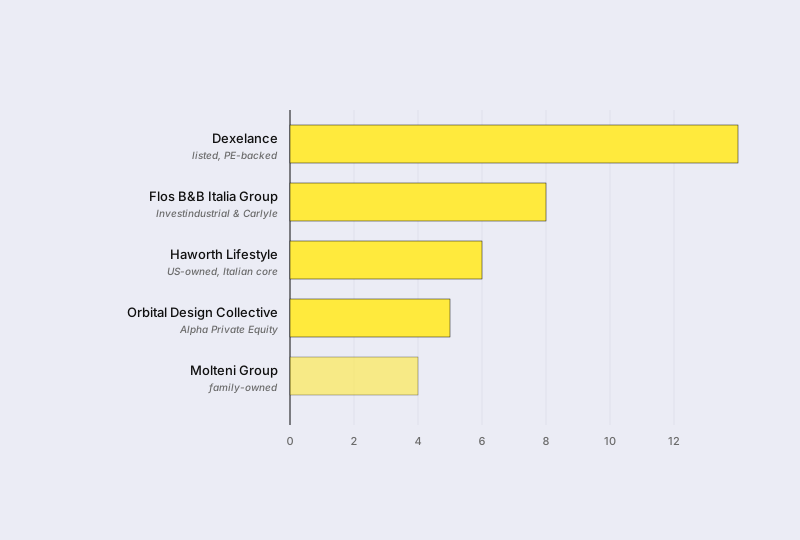
The internationally defining brands of Italian design are six houses that have turned the editor model into a global signature. Cassina from Meda holds the rights to pieces by Le Corbusier, Charlotte Perriand, Mackintosh and Rietveld and remains, through the iMaestri Collection, the central reference for design history within an active programme. B&B Italia from Novedrate has redefined high-end upholstery with Antonio Citterio, Patricia Urquiola and Naoto Fukasawa; the B&B Italia Project division delivers the contract-grade adaptations for hospitality and workplace spec. Molteni&C from Giussano combines residential furniture with Dada kitchens and the UniFor workplace sister under one corporate group. Poltrona Frau from Tolentino embodies the leather tradition of Made in Italy, with its own project division for yachts, theatres and premium hospitality. Cappellini from Carugo operates as an avant-garde editorial label within the Haworth federation. Kartell from Noviglio is the only brand of the group whose DNA comes from a single material — plastic — and which has remained independent under the Luti family.
Behind the top tier sits a denser layer of premium brands with heritage character and predominantly Italian ownership. Minotti from Meda dominates the internationally marketed premium sofa segment with its own showroom structures in London, New York and Milan. Flexform from Meda and Poliform from Inverigo carry the Brianza cluster forward with classically restrained design. Living Divani and Porro, both in the province of Como, stand for reduction and made-to-measure work. Lema, Baxter, Giorgetti and Tacchini serve premium residential segments, each with its own profile — Lema with residential furniture and wardrobe systems, Baxter with leather and experimental materials, Giorgetti with woodworking craft, Tacchini with upholstery in an internationally gallerist style. Edra from Perignano stands for sculptural high-end pieces outside the editor model. Zanotta from Nova Milanese carries the design history of the 1960s and 1970s forward as a heritage brand under Haworth Lifestyle. Driade from Piacenza, founded in 1968 as an Italian editorial label, has been majority-owned by Spain's Kettal since 2026 — but remains Italian in heritage character.
Where the global design houses and premium family-owned brands carry the editor model, the contract and workplace specialists operate in a more serial and volume-oriented mode. UniFor from Turate delivers complete office systems with designs by Antonio Citterio, Foster + Partners and Renzo Piano among others, with its own Citterio sister company for partitions. Pedrali from Mornico al Serio is today probably the most important Italian hospitality and workplace chair manufacturer, with aluminium-based industrial production and ETO-capable order volumes. Arper from Monastier di Treviso, Magis from Torre di Mosto and Calligaris from Manzano fill the spectrum between design-led editorial lines and volume-capable contract production. Quadrifoglio Group and Frezza, both from the Veneto, are classical office system suppliers whose strength lies in industrial logistics. Kastel, Sitland and Estel Group supply seating along with integrated acoustic and workplace concepts. Tomassini operates at the crossover between workplace spec and design-led range.
Within this group, a distinct sub-cluster of Italian office furniture brands has emerged for international workplace tendering — Quadrifoglio Group, Frezza, Tomassini and Kastel as office system specialists, Pedrali and Arper as chair-driven crossover players, UniFor and Estel Group as high-end integrators. For specifiers searching internationally for Italian office furniture, this sub-cluster represents the credible answer to high-volume project work with EU-compliant logistics and predictable lead times.
The Italian lighting industry is closely interwoven with the furniture industry — many designers work for both sectors in parallel, and specifier packages often include furniture and lighting as a joint position. Flos, part of Flos B&B Italia Group, dominates the architectural premium segment with classics by Castiglioni and contemporary work by Patricia Urquiola and Michael Anastassiades. Artemide from Pregnana Milanese holds the second leading position with a focus on technical architectural lighting and remains in Italian family ownership. Luceplan from Milan, founded in 1978 and after years under Signify (Philips Lighting) part of Orbital Design Collective since 2019, combines the Italian design heritage with the industrial platform of the Calligaris group. Foscarini from Marcon works consistently author-driven with a decorative focus. Oluce from Milan is the heritage classic with re-editions of Magistretti, Sarfatti and Castiglioni. FontanaArte and Nemo both belong to Milan-based Nemo Group under Federico Palazzari. Davide Groppi from Piacenza, part of the Dexelance group, is the contemporary voice with minimalist light architecture.
Beyond the brands presented here, the furnomics brand directory documents the full breadth of the Italian furniture and lighting market — from heritage upholstery makers like Natuzzi Italia through designer labels like Cattelan Italia and Bonaldo to specialised suppliers for outdoor furniture, acoustics and components. Structural fragmentation remains characteristic of the Italian market: a handful of internationally visible groups and family businesses are followed by a broad layer of smaller workshops whose visibility runs primarily through multi-brand specifier platforms and the Salone network.
Italian design is author-driven and sculptural, Scandinavian is reductionist and craft-based, German is engineering-led and systemic. In day-to-day specifier work Italian furniture is usually placed as statement pieces — a Cassina lounge in reception, a Minotti sofa in the boardroom — while Scandinavian brands like Fritz Hansen or Carl Hansen & Søn furnish entire areas and German manufacturers like Wilkhahn or Sedus deliver the system architecture in workplace projects.
For hospitality and premium residential, B&B Italia Project, Cassina Contract, Poltrona Frau and Molteni Contract dominate the upper segment. In the mid-price range with high volume and short lead times, Pedrali, Arper, Calligaris, Quadrifoglio Group and Kastel deliver. For workplace projects, UniFor and Estel Group are the structurally most viable suppliers, complemented by office system specialists like Frezza and Sitland.
Italian office furniture has consolidated around a clear sub-cluster: Quadrifoglio Group, Frezza, Tomassini and Kastel as office system specialists; Pedrali and Arper as chair-driven crossover players with strong export operations; UniFor and Estel Group as high-end integrators for complete office environments. The cluster combines design credentials with industrial logistics, EU-compliant supply chains and predictable lead times — making it the realistic answer for international workplace projects looking for an Italian source.
Three factors drive the price: licence fees to designer estates for iconic pieces such as the Le Corbusier line at Cassina; high-quality material processing with in-house leather plants, veneer techniques and marble integration; and small batch sizes with a workshop element even in industrial production. For the Cassina LC4 chaise longue, royalties flow per unit to the Le Corbusier Foundation and to the heirs of Pierre Jeanneret and Charlotte Perriand, raising the price considerably over functionally comparable pieces without authorship.
Unlike German office systems, where a large series is tendered and calculated, the tendering of Italian furniture usually runs through project divisions like B&B Italia Project or Cassina Contract. These deliver adjusted upholstery, more robust padding and project-specific dimensions on the basis of the standard collection. Volume projects in the mid-hospitality segment run through Pedrali, Calligaris or Quadrifoglio Group, often with European logistics and volume discounts. For premium lounges and reception areas the specifier question remains concentrated on a few editor brands.
Four investor groups hold the premium tier today: Haworth Lifestyle from the US with Cassina, Poltrona Frau, Cappellini and Zanotta; Flos B&B Italia Group under Investindustrial and Carlyle with B&B Italia, Maxalto, Flos and Louis Poulsen; the listed Dexelance with Gervasoni, Meridiani, Saba Italia and Turri; and the PE-financed Orbital Design Collective with Calligaris, Connubia, Ditre Italia, Luceplan and Fatboy. The Molteni Group remains owner-led under the Molteni family. Flos B&B Italia Group announced in July 2025 that it would in future sell brands individually — effectively ending the consolidation phase.
The Digital Product Passport (DPP) is being phased in for furniture under the EU ESPR regulation in the Working Plan 2025–2030, with full ESPR application starting on 19 July 2026 and a product-specific delegated act expected in 2027 to 2028. Mandatory furniture DPPs come into force, after an 18-month compliance window, in 2029 at the earliest. Volume manufacturers with ISO-certified supply chains are technically prepared, while smaller premium workshops face considerable documentation work on material, origin, repairability and recyclability.
The Salone del Mobile has been the global trade fair for high-quality furniture since 1961 and remains the central specifier platform for Italian brands — even as dedicated contract fairs like Orgatec, HD Expo and BDNY have grown stronger in their respective sectors. With its 64th edition in 2026, the Salone launched Salone Contract, a multi-year initiative with a master plan by OMA, whose first full exhibition is scheduled for 2027. In parallel, the Fuorisalone's centre of gravity keeps shifting toward Brera (editorial brands) and Durini (specifier showrooms).
Italian design is part of a wider fabric of design cultures, sectors and market platforms that overlap in contract work. The following topics either complement or delimit the Italian hub.
Read more …Italian design: manufacturers in the contract market
Residential contract furniture describes the institutional furnishing of multi-unit residential developments that operate outside the classical owner-occupier housing market — branded residences under luxury hotel marques, purpose-built student accommodation (PBSA), build-to-rent and multifamily apartment portfolios, and serviced apartment chains for corporate stay. Unlike the consumer furniture market, these segments share an institutional procurement logic: dozens to thousands of apartment units furnished in coordinated roll-outs, specified for ten to fifteen years of intensive use, and procured by professional operators, asset managers, or development teams.
The European and North American markets are dominated by three distinct supplier ecosystems. Premium residential brands like Molteni&C, Poliform, B&B Italia Project, and Minotti supply the luxury branded residences segment with architect-led specifications. Student housing and PBSA suppliers like KI, University Furnishings, and Sauder Education serve the high-volume institutional student accommodation market across the US and UK. Turnkey furniture-package specialists like BelForm in Germany and Indigo Living internationally deliver complete furnished units to serviced apartment operators and corporate landlords.
Residential contract furniture covers the supply of furniture and complete furnishing packages to institutional residential developments — that is, residential properties that are not sold individually to private owners but operated, rented, or licensed as units by professional operators. The category spans premium branded residences, build-to-rent and multifamily apartments, purpose-built student accommodation, and serviced apartments for corporate stay. What unites these segments is the institutional procurement logic: bulk specification, roll-out logistics, long lifecycle planning, and professional fleet management of furniture across dozens to thousands of units.
The residential contract market subdivides into four distinct segments with their own operator structures, procurement logics, and design conventions. Branded residences are residential properties licensed under luxury hotel or fashion brands — Mandarin Oriental, Ritz-Carlton, Bulgari, Six Senses, Armani — typically sold to high-net-worth buyers with hotel-style services. Purpose-built student accommodation (PBSA) describes the UK and increasingly continental European market for institutionally developed student housing, with operators like Unite, Empiric, and iQ Student Accommodation managing tens of thousands of beds. Build-to-rent (UK) and multifamily (US) describe institutionally developed and operated rental apartment portfolios, with operators like Get Living and Quintain in the UK and Greystar and AvalonBay in the US. Serviced apartments and aparthotels serve the corporate stay and project housing market with hotel-like services and longer stays than classical hotels.
The four segments have developed asymmetrically across geographic markets. Branded residences are a globally consistent premium segment, dominated by partnerships between international hotel brands and high-end residential developers in cities like Dubai, Miami, London, New York, Singapore, and increasingly Munich, Vienna, and Berlin. PBSA is a UK-led market that has begun to spread across Europe, with the Netherlands, Spain, Portugal, and Germany as growth markets; the US college dorm segment operates under different conventions with on-campus university housing dominant. Build-to-rent originated in the US multifamily tradition and has spread to the UK in the 2010s, where it now represents a major institutional asset class; continental European markets lag behind. Serviced apartments are strongest in business travel hubs across Europe and Asia, with continental Europe historically less developed than the UK and Asia-Pacific.
Residential contract furniture borders on several adjacent sectors with overlapping requirements. Hospitality furniture covers shorter-stay hotel accommodation with higher turnover and more standardized design conventions; serviced apartments and branded residences share many specification logics with hospitality but require greater residential warmth, kitchen furnishings, and longer-stay comfort. The classical owner-occupier residential market is served by the consumer furniture industry through retail channels and operates outside the contract logic entirely. Senior living and assisted housing share the institutional procurement structure but require age-specific specifications around mobility, hygiene, and care equipment. Across all four segments, the boundary with hospitality is the most permeable: many manufacturers serve both, and the conceptual hybrids between hotel and apartment (Numa, Limehome, Apartments by Marriott Bonvoy) are accelerating the convergence.
Residential contract furniture must satisfy three requirement layers simultaneously: durability under intensive multi-tenant use, compliance with jurisdiction-specific fire safety and hygiene regulations, and economic viability across institutional procurement structures. Unlike the consumer furniture market, where the individual purchase decision dominates, residential contract follows a roll-out logic: what is specified for a pilot apartment must be reproducible, calculable, and maintainable across hundreds or thousands of units over ten to fifteen years.
Institutional residential furnishing is typically procured as complete package specifications rather than as individual pieces. A standard package for a 30 to 45 square meter apartment includes bed and mattress with bedding set, wardrobe or open garment storage, desk with task chair, sofa or sofa-bed, coffee table, dining table with two to four chairs, fully equipped kitchen with cookware and tableware, multi-level lighting, curtains or blackouts, and a bathroom with towel set and starter amenities. Turnkey specialists like BelForm in the German market and Indigo Living internationally have built their business model around specifying, warehousing, delivering, and installing these complete packages — typically in coordinated logistics floor by floor in parallel with construction. For larger developments with hundreds of units, turnkey delivery substantially reduces operator coordination costs.
Residential contract furniture must meet jurisdiction-specific safety standards that vary significantly across markets. In the United Kingdom, the Furniture and Furnishings (Fire) (Safety) Regulations require all upholstered furniture in rental and serviced accommodation to meet stringent ignitability tests. In the United States, the NFPA 260 and NFPA 261 standards govern upholstered furniture flammability, alongside state-level regulations such as California's TB 117-2013. In the EU and UK, EN 1021-1 and EN 1021-2 set the corresponding upholstery ignition tests, while EN 13501-1 classifies overall material fire behavior. Beyond fire safety, durability standards from BIFMA (US) and EN 16139 (EU, originally for contract seating) define minimum performance for institutional use. Hygiene requirements are particularly demanding in serviced apartments and student housing: textiles must be industrially washable or feature removable covers, surfaces must resist disinfectants, and mattresses must support waterproof or anti-bedbug encasings.
The procurement logic in residential contract varies substantially by ownership and operating structure. In owner-operated developments — common in serviced apartments and some PBSA operators — the operator's internal procurement team decides directly, often with framework agreements for standard components. In lease or management models where an operator runs an asset owned by an institutional investor (pension fund, insurance company, real estate fund), furnishing is typically governed by a separate FF&E (Furniture, Fixtures, and Equipment) agreement specifying who finances, owns, and replaces the furniture. In branded residences, the licensing hotel brand often dictates minimum specification standards while developer or buyer covers the actual cost. This complex structure explains why specialist FF&E procurement firms like Benjamin West, HVS Design, and Wilson Associates play a substantial role in the upper tiers of the market, coordinating between operator, investor, brand, and supplier.
The residential contract market has expanded substantially over the past decade, driven by institutional capital flowing into rental housing, the globalization of premium brands into residential real estate, and shifts in how people live, work, and travel. Four developmental lines particularly shape the market today.
Branded residences are among the fastest-growing real estate segments globally. The pioneering markets — Dubai, Miami, London, New York, Singapore — have seen sustained development since the 2000s, with thousands of units sold annually under marques like Mandarin Oriental, Ritz-Carlton, Bulgari, Four Seasons, and Aman. Newer luxury entrants like Six Senses, Rosewood, and Edition Hotels have built branded residences into their core development strategy, while fashion brands like Armani, Versace, and Bulgari have established their own residential lines. European markets, historically underdeveloped in this segment, are catching up: Munich, Vienna, Berlin, Madrid, and Lisbon all see active branded residences pipelines for the late 2020s. For furniture manufacturers, this segment is particularly attractive because branded residences carry premium furniture budgets, top-tier architectural specification, and brand-driven design requirements — favoring Italian premium brands like Molteni&C, Poliform, B&B Italia Project, and Minotti.
Purpose-built student accommodation (PBSA) has transformed the UK student housing market over the past two decades, with institutional operators like Unite Students, Empiric, iQ Student Accommodation, and Scape now managing hundreds of thousands of beds across the country. The UK model has begun expanding into continental Europe, with strong growth in the Netherlands, Spain, Portugal, Germany, and Italy. In the United States, the parallel market operates differently: on-campus university housing is procured directly by universities, often through cooperative purchasing programs and direct contracts with student housing specialists like KI, University Furnishings, Sauder Education, and Smarter Furnishings. Both markets share a specification logic favoring extreme durability, modular construction, fire safety compliance, and increasingly hospitality-inspired design as operators compete for student preference. The annual replacement and refurbishment volumes in this segment are substantial — typically every five to seven years for high-wear components.
The build-to-rent (BTR) market in the United Kingdom has grown from a marginal segment in the early 2010s to an established institutional asset class with over a hundred thousand units completed or in pipeline. Operators like Get Living, Quintain Living, Greystar UK, and Way of Life manage entire purpose-built rental communities, often offering partially or fully furnished apartments alongside unfurnished options. The US multifamily market, the world's largest institutional rental housing segment with over 40 million units, operates at substantially greater scale through operators like Greystar, AvalonBay, Equity Residential, and Camden Property Trust. Furniture procurement varies: many units are rented unfurnished with tenants supplying their own furniture, but furnished options, corporate housing programs, and dedicated furniture rental services from CORT Furniture Rental and Brook Furniture Rental serve substantial sub-segments. UK build-to-rent furniture packages are increasingly procured through specialized package providers such as David Phillips, Inside Out Contracts, and dedicated arms of national furniture retailers.
With ESG reporting requirements for institutional investors, sustainability has shifted from marketing to specification in residential contract procurement. Apartment operators with pension fund or insurance company investors increasingly substantiate their FF&E procurement with EPDs (Environmental Product Declarations), FSC or PEFC timber certifications, REACH-compliant textiles, and Cradle-to-Cradle assessments. At the same time, the importance of durable and repairable furniture is rising: where complete replacement after seven to ten years was once standard, progressive operators increasingly specify modular constructions with replaceable upholstery, cushions, and wear components. For manufacturers, the supply of spare parts and refurbishment services becomes an increasingly important differentiator in tenders — particularly in PBSA and student housing, where annual wear-and-tear is most intensive.
The residential contract market is served by four distinct supplier groups corresponding to the four sub-segments. Premium residential brands dominate branded residences, dedicated PBSA and student housing specialists supply the institutional student accommodation market, build-to-rent package providers serve the UK and US rental sectors, and turnkey FF&E specialists deliver complete furnishing packages to serviced apartment operators. The following overview organizes the most relevant manufacturers and suppliers by market role.
The branded residences segment is dominated by the Italian residential industry with its project and contract divisions. Molteni&C and its sister companies UniFor and Dada deliver complete apartment fit-outs for international branded-residence projects from New York to Dubai. Poliform has built Poliform Contract as a dedicated project division regularly specified in premium residential projects. B&B Italia Project, Maxalto, and Minotti serve the luxury segment with hotel-brand partnerships and architect specifications. Poltrona Frau, Cassina, and Cappellini — all part of Haworth Lifestyle Design — complete the premium spectrum. Walter Knoll delivers comparable premium quality from the German-speaking region and is regularly specified in European branded residence projects. In the upper mid-market segment, Flexform, Living Divani, Lema, Porada, Giorgetti, and Wittmann round out the spectrum.
The student housing segment is served by dedicated suppliers with deep specialization in the institutional accommodation market. In the United States, KI from Green Bay, Wisconsin leads the segment with comprehensive residence hall and dormitory furniture lines, alongside University Furnishings, Sauder Education, Smarter Furnishings, Slumberland's collegiate division, and New England Woodcraft. F3 Student and Ecologic Furniture compete in dedicated sub-segments of the US college market. In the United Kingdom, the PBSA furniture market is served by specialists like Furniturebox Contracts, Roomservice by CORT, David Phillips, and Inside Out Contracts, who supply complete furniture packages to operators like Unite Students, iQ, and Empiric. UK contract furniture supplier Skopos and the Spanish manufacturer ACTIU serve common areas and study lounges, while Nowy Styl from Poland is regularly specified across European PBSA developments. Increasingly, hospitality-trained manufacturers like Pedrali and Andreu World supply lounge furniture for PBSA common areas as operators upgrade their amenity offerings to compete for student preference.
The build-to-rent and multifamily segments are served by specialized furniture package providers and rental specialists rather than by traditional furniture manufacturers. In the United Kingdom, David Phillips, Inside Out Contracts, and Furniturebox Contracts lead the build-to-rent furniture packages market with bulk-specified complete apartment fit-outs. In the United States, the multifamily furniture market is served primarily by furniture rental specialists like CORT Furniture Rental (a Berkshire Hathaway subsidiary) and Brook Furniture Rental, alongside outright furniture suppliers for operator-furnished units. Some major US multifamily operators like Greystar maintain in-house FF&E specification teams that procure directly from manufacturers including hospitality-trained brands like Andreu World, Pedrali, and Arper for common areas and amenity spaces. For outdoor multifamily furniture in pool and courtyard environments, US specialists like Landscape Forms and Wabash Valley Manufacturing serve substantial volumes.
Serviced apartments and corporate housing represent the segment with the strongest dedicated supplier specialization. In Germany, BelForm from Eltville am Rhein is the leading turnkey FF&E specialist, supplying complete apartment fit-outs to operators like Adina, Living Hotels, and Brera Serviced Apartments. Internationally, comparable specialists include Indigo Living (Hong Kong, with European presence), FF&E Catalysts, and MGSM. Hospitality-specialized FF&E procurement firms like Benjamin West, HVS Design, and Wilson Associates operate at the upper end of the market, coordinating between operator, investor, hotel brand, and supplier networks. In bedding and mattresses — a particular specialty in serviced apartments due to high turnover and longer stays — Auping, Hästens, Magniflex, and Tréca supply contract bedding systems. For sleeper sofas, particularly relevant in apartment furnishing, COR, Brühl, and Bonaldo bring long-standing expertise to the segment.
A complete, alphabetically sorted overview of all manufacturers in the furnomics brand directory with residential contract relevance is available in the Brands A–Z index. Filtering by the relevant sectors (Residential Contract & Luxury, Hospitality, Workplace) is available through the brand overview page.
Residential contract furniture describes the institutional furnishing of multi-unit residential developments that operate outside the classical owner-occupier housing market — branded residences under luxury hotel marques, purpose-built student accommodation, build-to-rent and multifamily apartment portfolios, and serviced apartment chains for corporate stay. What unites these segments is the institutional procurement logic: bulk specification, roll-out logistics, long lifecycle planning, and professional fleet management of furniture across dozens to thousands of units.
Branded residences are residential properties licensed under luxury hotel or fashion brands — Mandarin Oriental, Ritz-Carlton, Bulgari, Six Senses, Aman, Armani — typically sold to high-net-worth buyers with hotel-style services. The segment is among the fastest-growing real estate categories globally, with pioneer markets in Dubai, Miami, London, New York, and Singapore, and rapidly expanding pipelines in European cities like Munich, Vienna, Berlin, Madrid, and Lisbon for the late 2020s.
PBSA stands for purpose-built student accommodation — the UK and increasingly continental European market for institutionally developed student housing, operated by specialist companies like Unite Students, iQ Student Accommodation, Empiric, and Scape across hundreds of thousands of beds. The US college dorm market operates differently: on-campus university housing is procured directly by universities, often through cooperative purchasing programs and direct contracts with student housing specialists like KI, University Furnishings, and Sauder Education. Both markets share specification requirements around extreme durability, fire safety compliance, and increasingly hospitality-inspired design.
Build-to-rent (BTR) and multifamily describe the same fundamental asset class — institutionally developed and operated rental apartment portfolios — but with different terminology in the United Kingdom and United States. The US multifamily market is the world's largest institutional rental housing segment with over 40 million units and operators like Greystar, AvalonBay, and Equity Residential. The UK build-to-rent market emerged in the 2010s and now exceeds one hundred thousand units in completion or pipeline, with operators like Get Living, Quintain Living, and Way of Life. Furniture procurement varies substantially: many units are rented unfurnished with tenants supplying their own furniture, but furnished options, corporate housing programs, and dedicated furniture rental services serve substantial sub-segments.
The branded residences segment is dominated by the Italian residential industry with its project divisions. Molteni&C, Poliform Contract, B&B Italia Project, Maxalto, and Minotti deliver complete apartment fit-outs for international projects from New York to Dubai. Poltrona Frau, Cassina, and Cappellini complete the premium spectrum. Walter Knoll delivers comparable premium quality from the German-speaking region. In the upper mid-market, Flexform, Living Divani, Lema, Porada, Giorgetti, and Wittmann round out the spectrum.
Residential contract furniture must meet jurisdiction-specific safety standards. In the United Kingdom, the Furniture and Furnishings (Fire) (Safety) Regulations require all upholstered furniture in rental and serviced accommodation to meet stringent ignitability tests. In the United States, NFPA 260 and NFPA 261 govern upholstered furniture flammability, alongside state-level regulations such as California's TB 117-2013. In the EU and UK, EN 1021-1 and EN 1021-2 set the corresponding upholstery ignition tests, while EN 13501-1 classifies overall material fire behavior. Beyond fire safety, durability standards from BIFMA (US) and EN 16139 (EU) define minimum performance for institutional use.
Procurement logic varies substantially by ownership and operating structure. In owner-operated developments, the operator's internal procurement team decides directly, often with framework agreements for standard components. In lease or management models where an operator runs an asset owned by an institutional investor, furnishing is typically governed by a separate FF&E agreement specifying who finances, owns, and replaces the furniture. In branded residences, the licensing hotel brand often dictates minimum specification standards while developer or buyer covers the actual cost. Specialist FF&E procurement firms like Benjamin West, HVS Design, and Wilson Associates play a substantial role in the upper tiers, coordinating between operator, investor, brand, and supplier.
Residential contract furniture is part of the broader contract furniture market, which divides into several sectors with their own internal logics. The following topic areas complement the residential contract segment or define its boundaries.
Read more …Residential contract furniture: branded residences, student housing, and build-to-rent