Healthcare furniture: manufacturers, standards and specifications
Cleanability decides. What separates healthcare furniture from every other contract segment is a simple question: how does a piece of furniture respond to years of disinfection? Upholstery fabrics must be alcohol-resistant, seams must be sealed, surfaces must resist scratching from stainless-steel instruments. Only then come fire safety, MDR classification, ergonomics, acoustics, aesthetics. This hierarchy explains why the manufacturer landscape is its own — those who deliver medical office furniture, patient room furniture or senior living furniture command a material technology that workplace and hospitality manufacturers have yet to build when entering the segment.
Four worlds under one roof: the medical office with its waiting room and exam space, long-term care with resident rooms and common areas, the hospital with patient rooms and treatment areas, behavioral health with its anti-ligature requirements. Each follows its own standards, its own procurement paths, its own specifier routines — from the private practice operator and the facility manager to the infection-control specialist and the FGI-guidelines-compliant healthcare planner. This hub brings the four worlds together, not because they are identical, but because they all share the same underlying question: how does furniture withstand daily disinfection without looking like it belongs in a hospital?
What healthcare furniture means in the contract sector
Healthcare furniture has no single, agreed-upon definition. Unlike workplace or hospitality, where specifiers and manufacturers have settled on shared sector terminology, the global healthcare furniture market splits into multiple disconnected worlds — each with its own procurement logic, its own standards, its own manufacturer landscape. Those who specify in the sector move between medical offices and senior living communities, between outpatient and inpatient care, between private clinics and public rehabilitation facilities.
Distinguishing healthcare furniture from consumer furniture
Healthcare furniture in the contract sector differs from consumer furniture in three ways: documented cleanability against alcohol-based disinfectants, code-compliant material specifications, and project-scale quantity availability. A lounge chair from a retail furniture store may look the part in a waiting room — but it is neither built for thousands of disinfection cycles nor available in the quantities a medical office buildout or senior living project requires. This distinction is what the term contract furniture covers: the commercial furniture sector as a whole, of which healthcare is one subsegment among several.
Market and key players
The specifier landscape in healthcare is more heterogeneous than in neighboring segments. While architects and interior designers dominate specification in workplace, and FF&E procurement managers set the tone in hospitality, healthcare specification brings together healthcare planners, private practice operators, nursing directors, facility managers, and in larger facilities infection-control specialists. This variety shapes procurement: medical office furniture in many markets is sourced through specialized dealers who bundle manufacturer assortments into practice-ready packages. The acute care and long-term care segments, by contrast, are dominated by structured tendering processes with direct manufacturer relationships.
The manufacturer landscape is leaner than in workplace or hospitality. A handful of specialists dominate their respective subsegments — Steelcase Health and MillerKnoll Healthcare (through Nemschoff) in acute care patient rooms, Kwalu in senior living, Pineapple Contracts and Norix in behavioral health. European manufacturers add a complementary profile: Wiesner-Hager Care and Dauphin in outpatient and senior living, Ropox in height-adjustable care solutions, Ponte Giulio in rehabilitation equipment. Larger workplace players such as Teknion and Humanscale enter healthcare through dedicated healthcare lines, often in conjunction with architecture firms working across both workplace and healthcare projects.
Subcategories of healthcare furnishing
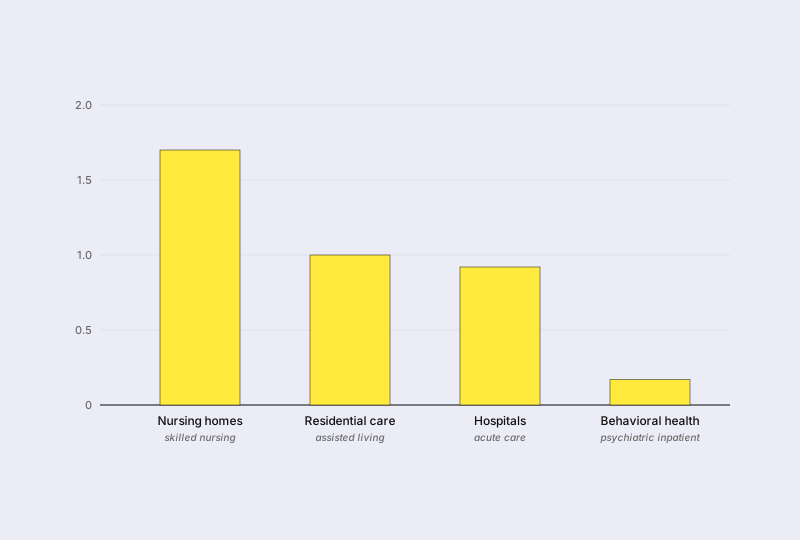
Healthcare furnishing breaks down into four primary subsegments. Medical office furniture covers the outpatient setting — from the waiting room of the medical office to exam rooms, therapy spaces and dental practices. Senior living furniture and long-term care furniture serve residential elder care, from resident rooms to community spaces. Acute care furniture, including patient room furniture, serves the inpatient hospital environment. Behavioral health furniture is its own distinct subsegment in the US and UK markets, with anti-ligature specifications for psychiatric facilities. Adjacent to these sits a growing crossover area with rehabilitation centers, medically oriented wellness hotels and senior resorts — spaces where healthcare standards overlap with hospitality logic.
The connective tissue between all subsegments is cleanability. This shared requirement is the functional common denominator that brings a treatment chair in a primary care office and a lounge sofa in a senior living community closer together than their differing usage contexts would suggest.


Requirements: hygiene, cleanability, fire safety
Healthcare furniture specification follows a regulatory logic that does not exist in this density in workplace or hospitality. Three requirement fields shape every procurement decision: cleanability against disinfectants, fire safety in public buildings, and workplace safety in inpatient care settings. Each field has its own standards, its own testing protocols, its own documentation obligations. Anyone specifying for larger hospital or long-term care projects must master all three.
Cleanability and disinfectant resistance
Cleanability is the central requirement in healthcare — and the most frequently underestimated. Furniture surfaces are wiped down multiple times daily in medical offices, often hourly in hospitals, with alcohol-based surface disinfectants. Over a furniture lifecycle of ten to fifteen years this produces tens of thousands of disinfection cycles, and every material must withstand them without yellowing, cracking or becoming porous.
In the US market, EPA-registered hospital-grade disinfectants set the de facto standard for compatibility testing. The Center for Health Design publishes evidence-based guidelines for surface specification. In Europe, EN 14885 defines requirements for chemical disinfectants, indirectly specifying which substances furniture surfaces must resist. ISO 22196 is the international testing standard for antimicrobial properties. In practice, healthcare furniture manufacturers work with bleach-cleanable and alcohol-resistant synthetic leathers (such as Spradling, Boltaflex or Ultraleather), HPL- or melamine-coated wood substrates and powder-coated metal frames. Traditional textile upholstery is essentially unspecifiable in clinical core areas — it appears only in waiting rooms and senior living community spaces, where cleaning frequency is lower.
Fire safety and MDR implications
Fire safety requirements vary substantially by market. In the US, NFPA 260 and NFPA 261 govern the flammability of upholstered furniture, with California Technical Bulletin 117-2013 setting the most widely adopted state-level standard. The Joint Commission references additional facility-level requirements. In the European market, EN 1021-1 and EN 1021-2 govern the ignitability of upholstered furniture; in the UK, BS 5852 Crib 5 sets a stricter benchmark commonly required in healthcare procurement.
A separate dimension opens once furniture is classified as a medical device. A simple waiting room chair is not a medical device. An exam chair with positioning function, a hospital bed with patient-assist features or a treatment couch with electric height adjustment, however, potentially falls under FDA medical device regulation in the US or the EU Medical Device Regulation (MDR 2017/745) in Europe. The result is expanded documentation, conformity assessment and post-market surveillance obligations that fundamentally change procurement logic: a furniture purchase becomes a medical device investment with its own risk classification. Manufacturers such as Stiegelmeyer in patient beds or Ropox in height-adjustable care solutions operate under MDR compliance as standard — generalist contract furniture manufacturers typically do not.
FGI Guidelines and workplace safety in care
In long-term care and acute care environments, a further requirement layer comes into play that does not apply in outpatient practice: workplace safety for care staff and design guidelines for healthcare facilities. In the US, the Facility Guidelines Institute publishes the FGI Guidelines for Design and Construction of Hospitals and FGI Guidelines for Design and Construction of Residential Health, Care, and Support Facilities — the foundational documents referenced by healthcare authorities in most US states and increasingly cited internationally. These guidelines feed directly into furniture specification: patient beds must be electrically height-adjustable to enable ergonomic transfer work for nursing staff, resident wardrobes must be positioned to minimize bending and lifting, seating in common areas must support both mobility-impaired residents and transfer-assisting personnel.
This dual orientation — toward the resident and toward the nursing staff simultaneously — is the core competence of specialized long-term care manufacturers. It distinguishes inpatient long-term care furniture from the senior living segment in the US residential elder care market, where staff workplace safety is regulated through different channels. Specifiers working on FGI-compliant projects need manufacturers who can demonstrate compliance up front — generalist contract furniture manufacturers without healthcare experience often fail at the pre-qualification stage.
Current developments in healthcare furnishing
Healthcare furnishing is a slow-moving market. Investment cycles of ten to fifteen years, regulated procurement processes and conservative specifier routines slow the pace at which new concepts reach the sector. Still, four developments are emerging that will shape specification in the coming years — driven by demographic pressure, evidence-based design research, the rise of behavioral health as a dedicated subsegment, and the cleanability legacy of the pandemic.
Demographic pressure and senior living growth
Demographic change is by far the strongest driver in the global healthcare furniture market. In the US, the over-65 population is projected to grow by roughly 40 percent through 2040, with the over-85 segment growing even faster. Similar trajectories shape European, Japanese and Chinese markets. This creates massive investment demand in senior living and long-term care facilities — both new construction and refurbishment of existing properties. For the furniture industry it means: senior living is the fastest-growing subsegment within healthcare, with double-digit annual growth in individual product categories.
At the same time, expectations of care environments are shifting. The generation now entering senior living communities has different residential biographies than their parents — they were professionally mobile, lived in open rental markets, know urban living and co-living. Standardized institutional aesthetics are increasingly perceived as unacceptable, by residents and by adult children involved in facility selection. Manufacturers such as Kwalu, Bernhardt Hospitality and Wiesner-Hager Care respond with assortments that translate care functionality into a residential design language.
Healing environment and evidence-based design
The concept of the healing environment has moved from Anglo-American healthcare architecture discourse into mainstream specification. The underlying thesis is that the spatial and material design of medical and care environments has measurable influence on healing outcomes, pain perception and length of stay. Evidence-based design — the scientific study of these relationships — provides empirical support for design decisions that were previously made on intuition alone. The Center for Health Design and its EDAC certification have established this methodology as a standard reference in the US market.
For furniture specification this has concrete consequences. Sightlines and daylight orientation are now actively supported by furniture layout. Acoustic separation elements in waiting areas demonstrably reduce stress levels. Color and material selection is curated more systematically — muted natural tones and haptically warm surfaces displace the clinical white plastic aesthetic of earlier decades. In patient rooms, family seating moves into focus, because studies show that family presence accelerates recovery. This is not a design trend but an evidence-based specification decision.
Behavioral health as a distinct subsegment
Behavioral health furniture has emerged as the most clearly defined growth subsegment within healthcare, particularly in the US and UK markets. The driver is twofold: rising demand for inpatient mental health treatment capacity, and tightening regulatory requirements for ligature-resistant environments in psychiatric facilities. Pineapple Contracts (UK), Norix (US), Moduform and Stance Healthcare have built specialized assortments around anti-ligature design — eliminating attachment points, fixing furniture to floors and walls, using tamper-resistant fasteners.
What sets behavioral health apart from other healthcare subsegments is the depth of its specialization. Anti-ligature design is not a feature added to standard healthcare furniture; it is a constructive principle that runs through every detail of a product. Manufacturers without dedicated behavioral health lines do not compete in this segment. For specifiers, this creates a parallel manufacturer landscape: the behavioral health unit of a hospital is sourced from a different shortlist than the acute care floors of the same facility.
Cleanability as an ongoing post-pandemic theme
The Covid pandemic did not create new requirements in healthcare furnishing — it radicalized existing ones. Cleanability was a self-evident specification standard before 2020. After 2020 it has become an openly discussed differentiator that manufacturers actively market and specifiers explicitly query. Surface disinfection frequency has remained permanently elevated in many facilities, even after the acute pandemic phase ended.
This drives increasing material differentiation. Upholstery fabrics are now categorized by disinfectant resistance and supplied with testing protocols. Upholstered furniture is constructed with removable, machine-washable covers. Edge treatment, seams and joints are designed to eliminate cleaning dead zones where pathogens can accumulate. These detail optimizations are no longer marketing themes but are explicitly required in tender specifications — manufacturers who cannot deliver are eliminated at the pre-qualification stage.

Healthcare furniture manufacturers at a glance
The healthcare furniture manufacturer landscape is leaner than in workplace or hospitality. A few specialists dominate their respective subsegments — complemented by dedicated healthcare lines from larger workplace manufacturers that participate in larger hospital and rehabilitation projects. The following overview groups manufacturers by the four primary subsegments: medical office and outpatient, senior living and long-term care, acute care and patient room, and behavioral health.
Medical office and outpatient
Medical office furniture sits at the intersection between workplace ergonomics and clinical specification. Dauphin brings its workplace seating heritage into the medical office through its healthcare line, transferring ergonomic competence from office settings into exam rooms and treatment chairs. Wiesner-Hager covers the outpatient segment through its Care line, with particular strength in waiting room seating. Kusch+Co delivers seating solutions for medical offices and hospital waiting areas, often as part of larger long-term care projects from the same operator.
Internationally, the medical office segment is dominated by Steelcase through its Steelcase Health line, which after the Nemschoff integration also covers acute care assortments. MillerKnoll serves the segment through Herman Miller Healthcare and Nemschoff. Teknion and Humanscale participate in medical office projects where workplace and healthcare requirements merge — particularly in administrative areas of healthcare facilities and in physician on-call environments.
Senior living and long-term care
Senior living is the US-led subsegment within healthcare, with its own design culture and procurement logic. Kwalu leads SERP rankings for senior living furniture, with an assortment built around long-life materials and cleaning-friendly construction. Bernhardt Hospitality serves premium senior resorts with the same design language the company brings to boutique hotels — the most prominent crossover player between hospitality and senior living. Ropox specializes in height-adjustable solutions, from care-grade sinks to kitchen modules for accessible resident apartments.
In the European long-term care market, Stiegelmeyer is the unchallenged market leader for care beds and MDR-compliant nursing systems. Wiesner-Hager Care occupies the interface between office ergonomics and senior living common areas — armchairs and sofas that are care-grade and at the same time residential in feel. Together with Dauphin's healthcare line, this group defines the European specifier shortlist for inpatient long-term care projects.
Acute care and patient room
Acute care furnishing — patient rooms, exam rooms, hospital waiting areas — is dominated in the US market by dedicated specialists. KI Healthcare, Krug, Wieland Healthcare and Carolina deliver patient room furniture at the depth of specialization that defines the segment. Steelcase Health, through its Nemschoff line, holds the largest share of the acute care specifier shortlist. Recaro brings mobility competence from the automotive sector into patient transport and treatment seating.
In Europe, the acute care segment is served by a narrower manufacturer base. Stiegelmeyer delivers hospital beds and patient room equipment into larger hospital projects. Generalist healthcare lines from international manufacturers — Steelcase Health, MillerKnoll Healthcare — shape the picture more strongly than pure European players.
Behavioral health
Behavioral health furniture is the most specialized subsegment within healthcare, with its own dedicated manufacturer landscape. Pineapple Contracts (UK) is the global market leader for ligature-resistant furniture, supplying psychiatric hospitals, secure units and mental health facilities across the UK, US and increasingly continental Europe. Norix, Moduform and Stance Healthcare cover the US behavioral health market with comparable depth.
What distinguishes behavioral health manufacturers from adjacent healthcare specialists is the constructive specificity of their products. Anti-ligature design eliminates attachment points where ligatures could be fixed, replaces conventional fasteners with tamper-resistant alternatives, and uses weighted or fixed construction to prevent furniture from being lifted and used as a weapon. These are not features added to existing furniture lines but design principles that determine every detail of the product.
Complete healthcare manufacturer database
Beyond the manufacturers curated in this hub, furnomics maintains a complete brand database with over 1,000 profiles from the international contract furniture market. The healthcare section gathers manufacturers with dedicated health sector assortments, from European care specialists to international hospital furniture lines. The complete brand directory is searchable by sector and alphabetically.

Frequently asked questions about healthcare furniture
What is healthcare furniture?
Healthcare furniture is contract furniture for medical, care and therapeutic facilities — from medical offices to senior living communities, hospitals and rehabilitation centers. It differs from consumer furniture in documented cleanability against alcohol-based disinfectants, code-compliant material specifications and project-scale quantity availability. The segment splits into four primary subsegments: medical office, senior living and long-term care, acute care, and behavioral health.
What standards apply to healthcare furniture?
Three regulatory fields shape specification. Cleanability follows EN 14885 and ISO 22196 in Europe, with EPA registration as the de facto benchmark in the US. Fire safety is governed by NFPA 260 and California Technical Bulletin 117-2013 in the US, EN 1021 in Europe and BS 5852 Crib 5 in the UK. In long-term care and acute care settings, the FGI Guidelines for Design and Construction provide the foundational reference in the US, with state-level facility regulations layered on top. Furniture with medical-device functionality additionally falls under FDA regulation in the US or the EU Medical Device Regulation (MDR 2017/745) in Europe.
How does medical office furniture differ from hospital furniture?
Medical office furniture serves outpatient care in physician, dental and therapy practices. Hospital furniture, including patient room furniture, serves inpatient acute care. The differences lie less in materials than in procurement logic, project scale and regulatory requirements: medical office furniture is often sourced through specialized dealers in smaller quantities, hospital furniture mostly through structured tenders with direct manufacturer relationships. Hospital furniture is also subject to stricter fire safety requirements in egress paths.
What is behavioral health furniture?
Behavioral health furniture is a specialized subsegment of healthcare furniture designed for psychiatric and mental health facilities. Its defining characteristic is anti-ligature construction — the elimination of attachment points where a ligature could be fixed, the use of tamper-resistant fasteners, and weighted or fixed designs that prevent furniture from being lifted. Pineapple Contracts (UK), Norix, Moduform and Stance Healthcare lead this market. Manufacturers without dedicated behavioral health lines do not compete in this segment.
Are healthcare furniture pieces classified as medical devices?
Not all. A simple waiting room chair, a resident wardrobe or an exam stool is not a medical device. Furniture with functions that directly serve diagnostic or therapeutic purposes — hospital beds with patient-assist features, treatment couches with electric height adjustment, exam chairs with positioning function — can fall under FDA medical device regulation in the US or the EU MDR. Classification is performed by the manufacturer through the applicable conformity assessment procedure. Specialized healthcare manufacturers such as Stiegelmeyer or Ropox operate under medical device compliance as standard.
Which manufacturers dominate the global healthcare furniture market?
The US market is led by Steelcase Health (including Nemschoff after the MillerKnoll integration), KI Healthcare, Krug, Wieland Healthcare and Carolina in acute care; Kwalu and Bernhardt Hospitality in senior living; Pineapple Contracts, Norix, Moduform and Stance Healthcare in behavioral health. In Europe, Stiegelmeyer leads patient beds and long-term care, Wiesner-Hager Care and Dauphin lead outpatient and senior living, Ropox leads height-adjustable solutions, Ponte Giulio leads rehabilitation equipment. Workplace manufacturers Teknion and Humanscale participate through dedicated healthcare lines.
How does healthcare furniture differ from hospitality furniture?
Hospitality furniture is optimized for durability and atmospheric impact, healthcare furniture for cleanability and regulatory compliance. The requirement hierarchy is different: in hotels aesthetics come first, then durability; in clinical settings disinfectant resistance comes first, then fire safety, then design. The two worlds overlap in medically oriented wellness hospitality, premium rehabilitation clinics and senior resorts — where manufacturers who command both logics are in demand.
Related topics
Healthcare furnishing does not stand alone. The sector overlaps with neighboring contract furniture segments — in some subsegments so strongly that the boundaries effectively disappear for specifiers.
Workplace and healthcare meet at multiple points. Hospital administrative areas, physician on-call environments and medical research facilities follow office logics rather than healthcare standards in their furnishing. Conversely, manufacturers like Dauphin, Teknion and Humanscale carry ergonomic competence from the office into exam and therapy rooms. Healthcare planners working on complex projects regularly reach into workplace assortments from the same manufacturers.
Hospitality and healthcare converge particularly in the premium segment. Medically oriented wellness hotels, upscale rehabilitation clinics and senior resorts combine healthcare standards with hospitality atmosphere. Bernhardt Hospitality is the most prominent crossover player in the US market, supplying senior resorts with the same design language it brings to boutique hotels. Manufacturers specifiable in premium hospitality are increasingly considered for high-end senior resorts and wellness clinics as well.
Education is the less obvious adjacency. University hospitals, nursing schools and medical training facilities sit between education and healthcare furnishing. Manufacturers like Wiesner-Hager and Dauphin, who serve both sectors, benefit from this dual positioning.
Retail plays a punctuated role in the healthcare sector. Pharmacies, opticians and medical supply stores combine retail furnishing with consultation and fitting zones, which in turn carry their own cleanability and hygiene requirements. In outpatient settings the line between retail and medical office furniture is increasingly blurred.
Above all sits the term contract furniture — the overarching category of commercial furnishing of which healthcare is one segment among several. Those who understand healthcare benefit from looking at the neighbors: workplace, hospitality, education, retail, public spaces. They follow related standards, similar procurement logics, and in part the same manufacturers.