Senior living furniture: manufacturers, standards & care
Few segments of the contract furniture market confront specifiers with the dual brief that senior living furniture imposes: care home furniture must support bariatric loads of 250 kilograms, deliver dementia-appropriate contrast values, withstand surface disinfection at 60°C, and meet fire-safety classifications such as BS 5852 Crib 5 or EN 1021 — and at the same time look like furniture in a place residents call home, often for the final years of their lives. Manufacturers including Knightsbridge Furniture, Shackletons, Kwalu, and the care lines of established contract brands — Wiesner-Hager, Brunner, Casala, Dauphin — have built their programs around this tension over the past two decades. Healthcare furniture is clinical, hospitality furniture is hospitable; senior living furniture is the only contract segment that has to be both, and at the material level rather than the image level.
For architects and specifiers working on nursing home projects, care home extensions, dementia care units, and hospice environments, senior living has become a specification field in its own right — distinct from healthcare, which it adjoins technically, and from hospitality, with which it increasingly converges at the premium end. This hub maps the segment: definitions and demarcations, the standards that apply across European and North American markets, the demographic and structural shifts reshaping the discipline, and a curated directory of the manufacturers that set the benchmark in nursing home and care home furniture.
What senior living furniture means in the contract sector
Senior living furniture, in contract specification, denotes the furnishing of residential and partial-residential care environments — nursing homes, care homes, assisted living facilities, dementia care units, hospice settings, and adult day-care centers. The terminology varies regionally: senior living and nursing home furniture dominate North American practice, care home furniture is standard in the United Kingdom, and aged care furniture is the established term in Australia and New Zealand. The category describes a market in which care furniture is specified with extended warranty cycles, with compliance documented against regional care-home regulations, and with a tension between care-grade engineering and residential atmosphere that no other contract segment imposes in the same form. Unlike healthcare furniture, which targets acute medicine and clinical hygiene, senior living operates on a long-residency logic: residents arrive to stay, and the furniture is judged by how far it can stage a domestic setting without losing its institutional fitness.
Distinguishing senior living from consumer furniture
The confusion is routine: consumers searching for a care chair or recovery recliner land on medical-supply platforms — Devita, mc-seniorenprodukte, careline-shop in Germany; Amazon, eBay, and rehabilitation retailers in the English-speaking markets — that sell individual furniture pieces to private buyers with insurance reimbursement codes. The institutional senior living market operates differently. A care home lounge chair specified for a nursing home operator is tendered in project procurement, ordered in lot sizes from 80 to 400 units, engineered for ten to fifteen years of commercial use, supplied with removable covers washable at 60 to 95°C, certified for bariatric loads up to 250 kilograms, and classified for fire safety to BS 5852 Crib 5 in the UK or EN 1021-1/2 across continental Europe.
The consequence for architects and interior designers is one no other contract segment produces in the same form: the products available in the consumer market are simply unsuitable for institutional care, and the institutional programs are not offered through consumer channels. Care specialists such as Knightsbridge Furniture (United Kingdom) and Kwalu (United States) sell exclusively to nursing home operators, to architecture practices with care specialization, and to FF&E procurement managers — distribution runs through dealers and direct specifier relationships, not through furniture retail or online platforms. The separation of the two markets is therefore not only a price difference but a difference of channel, certification regime, and specification logic.
Market and key players
The European care home furniture market is shaped by a double consolidation. On the operator side, a small number of pan-European chains dominate: Korian (Paris, publicly listed), emeis (formerly Orpea, France), Alloheim and Domicil (Germany), Tertianum (Switzerland), and premium operators including Augustinum (Germany) and Sunrise Senior Living (UK and US). On the manufacturer side, pure care specialists — Knightsbridge Furniture, Shackletons (both United Kingdom), Kwalu (United States), and Drabert (Germany) — compete with the care lines of established contract brands. Wiesner-Hager (Austria), Brunner (Germany), Casala (Netherlands), and Dauphin (Germany) maintain care programs within broader workplace and education portfolios.
The British care furniture industry is internationally the most editorially and product-side developed: Knightsbridge and Shackletons set global benchmarks for dementia-appropriate lounge furniture, complemented by Repose Furniture as a specialist for clinical dementia environments. Specifiers in senior living come from a wider mix of disciplines than in hospitality or workplace: care home architects work with dementia consultants (internationally, the University of Stirling Dementia Services Development Centre is the reference; in the United States, the SAGE Federation provides comparable resources), with geriatricians, and with facility management directors of care chains who, as central buyers, often hold the actual specification decision. Furniture selection therefore rarely follows the architectural concept alone — it follows the framework agreements that operators negotiate with manufacturers across multi-site portfolios.
Subcategories of senior living furniture
The furnomics directory organizes senior living furniture into five primary subcategories. Care seating and dementia chairs include bariatric-rated seating, lift chairs, dementia chairs with contrast-coded upholstery, and reclining care chairs with electric backrest adjustment — the most ergonomically and technically demanding subsegment, dominated by care specialists alongside the ergonomic lines of established contract seating manufacturers. Furniture for common areas covers tables, chairs, and casegoods for dining rooms, day rooms, and small-group lounges, specified close to hospitality furniture in visual vocabulary but with different material and cleanability requirements. Resident room furniture includes wardrobes, bedside tables, casegoods, and the care bed — the latter a specialist segment in its own right, with Stiegelmeyer, Hermann Bock, and Hill-Rom among the leading global manufacturers.
Reception and entrance areas in premium senior living projects are increasingly specified like hotel lobbies, with lounge furniture that gives the residential brief visible expression. Accessibility and height-adjustable solutions, finally, cover height-adjustable kitchens, care-grade bathroom furniture, and transfer-assist systems, served in Europe most prominently by Ropox (Denmark) and Pressalit (Denmark). This categorization is a working schema rather than a fixed market definition: manufacturers cross category lines routinely — Wiesner-Hager delivers both resident rooms and common areas, Casala maintains care and education programs in parallel. The furnomics directory lists each manufacturer once, under its primary specification segment.

Requirements: dementia, safety, and fire compliance
Senior living is the only contract segment whose central regulatory architecture is neither European, national, nor uniformly federal, but instead a layered composite of design frameworks, voluntary care standards, and jurisdictional building codes that varies more sharply by region than any comparable specification field. Where healthcare furniture follows DIN EN 14885, ISO 22196, and the MDR within a clearly framed compliance regime, and hospitality furniture aligns with hotel-chain specifications, senior living furniture sits at the intersection of three requirement fields that do not individually constitute a closed standard: dementia-friendly design as a progressively formalized design discipline, technical care safety derived from general furniture norms with care-specific extensions, and fire safety governed by care-home regulations that vary by country and, in federal systems such as the United States and Germany, by state. Specifiers therefore work not from a single normative reference but from a matrix that manufacturers, operators, and architectural practices reconcile through project documentation and compliance dossiers.
Dementia-friendly design
The internationally authoritative reference for dementia-friendly furniture is the Dementia Services Development Centre at the University of Stirling, whose Dementia Design Audit has functioned as the de facto framework for dementia care environments since the late 1990s. The core principles are operational rather than aesthetic: contrast values between seating surfaces and floor surfaces of at least 30 LRV-point differential (Light Reflectance Value), so that residents with impaired spatial perception can recognize seating; avoidance of reflective surfaces that may be misread as water; avoidance of patterns on upholstery and flooring that can be interpreted as obstacles or holes; and furniture placement that supports wayfinding through sight-line continuity, since signage is no longer reliably processed in advanced dementia stages.
British care manufacturers — Knightsbridge Furniture, Shackletons, Repose Furniture — have built these requirements into their product development and material documentation, supplying LRV values per upholstery sample as a standard data point. North American practice has converged on the same framework through the influence of the Eden Alternative and the Person-Centred Care movement, with the Pioneer Network and the LeadingAge association of nonprofit senior living providers translating the design principles into operational guidance for US care homes. In continental Europe, the discipline is less formalized: the Demenz Support Stuttgart in Germany and equivalent national resources elsewhere have issued recommendations, but a binding audit procedure is not in place. The consequence is a market asymmetry — British and North American care homes specify dementia-friendly furniture as a standard tender requirement, while continental European practice varies by operator and the formal compliance is often left to care home architects who introduce the Stirling principles themselves.
Fall prevention, bariatric loads, and cleanability
The technical care safety of a senior living furniture piece rests on three pillars, each following its own normative or advisory logic. Fall prevention is framed in the United States by CMS guidance and by the FGI Guidelines for Design and Construction of Residential Health, Care, and Support Facilities; in the United Kingdom by the Care Quality Commission and by NICE clinical guidelines; and in the DACH region by the Expertenstandard Sturzprophylaxe of the German Network for Quality Development in Care (DNQP). The operational requirements converge across jurisdictions: seat heights between 18 and 19 inches (46 to 48 centimeters), armrests engineered as transfer aids with defined grip geometry, elevated tip stability beyond standard contract chair minimums, slip-resistant bases, and anti-tip construction for tip-prone furniture. Care specialists document these properties at the product level; manufacturers with hospitality or workplace backgrounds entering the senior living segment through care lines typically supply the documentation on a project basis.
Bariatric loads are the fastest-growing specification field in senior living furniture. The 290- to 330-pound (130 to 150 kg) standard typical in the 2000s and early 2010s has shifted in recent tenders toward 440 to 550 pounds (200 to 250 kg) — a consequence of rising obesity rates in resident populations, documented in the United States by the CDC and in Europe by national equivalents, which have been steadily climbing since the mid-2010s. Bariatric adaptation affects not only seat load but also seat width (21 to 24 inches, or 54 to 60 centimeters, rather than the 18.5-inch standard) and frame construction. Cleanability, finally, follows infection-control guidance from the CDC in the United States, the Department of Health in the United Kingdom, and the Robert Koch Institute in Germany: removable covers washable at 60 to 95°C, seamless upholstery construction, antimicrobial surface treatments, and cover fabrics that withstand surface disinfection with alcohol-based or oxidative agents — specifications unknown in the workplace segment and required in comparable rigor only in intensive-care areas of the healthcare segment.
Fire safety and regional regulations
Fire safety for senior living furniture follows a doubled regulatory architecture. At the European level, EN 1021-1 (smoldering cigarette test) and EN 1021-2 (match flame test) function as minimum standards for upholstered furniture; the UK market sharpens the requirement considerably through BS 5852 Crib 5, mandatory for furniture in NHS-funded care facilities and effectively standard across the British care home sector. France references M1 or M2 under NF P92-503. In the United States, the regulatory architecture is set by NFPA 260 (Standard Methods of Tests and Classification System for Cigarette Ignition Resistance of Components of Upholstered Furniture) and NFPA 261, supplemented by California Technical Bulletin 117-2013 and by state fire-marshal codes that vary by jurisdiction. German care homes additionally face DIN 4102 B1 for fire-retardant upholstered furniture, mandatory above defined facility sizes under the federal-state Heimbauverordnungen.
The actual compliance challenge in senior living, however, lies less in the fire classifications themselves — which are manufacturer-documented and material-controllable — than in the care home building regulations that, in federal systems, devolve to state level. In Germany since the 2006 federalism reform, sixteen separate state regulations have evolved in parallel: North Rhine-Westphalia regulates through the Wohn- und Teilhabegesetz, Bavaria through the Pflege- und Wohnqualitätsgesetz, Baden-Württemberg through the Landesheimgesetz, and so on across all federal states. The United States runs a comparable structure through state Departments of Health licensing, with assisted living and skilled nursing requirements varying significantly between states. For pan-regional operator chains such as Korian, Brookdale, or Sunrise Senior Living, the practical consequence is that a single furnishing program must be executed against sixteen state regulations in Germany or fifty in the United States — a reality rarely communicated openly within the industry, but one that fundamentally shapes the program design of care manufacturers operating across jurisdictions.

Current developments in senior living
Senior living is the second contract sector, after hospitality, in which the specification logic has shifted so visibly over the past decade that a contemporary tender bears little resemblance to one written in 2015. Four developments drive the shift: demographic compression as an investment thesis, the displacement of the specification benchmark toward residential atmosphere, the consolidation of the operator landscape onto a small number of pan-continental chains, and the convergence between senior living and hospitality in the premium segment. They do not run in synchrony, and their interactions are more complex in detail than any single trade-press item suggests — but together they explain why the care manufacturers setting the benchmark today are different from those that defined the segment a decade ago.
Demographic shift as investment driver
Demography is the exceptional condition of senior living and, simultaneously, the reason the segment carries the only growth thesis in the contract market that is decoupled from the broader economic cycle. Eurostat projects the EU-27 population aged 80 and over rising from roughly 26 million in 2024 to a forecast 50 million by 2050; the United States Census Bureau projects a parallel rise from 13 million Americans aged 85 and over today to more than 19 million by 2050. The German Federal Ministry of Health forecasts care recipients rising from 5.2 million in 2023 to more than seven million by 2055, with the Federal Institute for Research on Building, Urban Affairs and Spatial Development (BBSR) estimating residential care capital expenditure requirements in the mid-three-digit billions by 2040. The result is visible: senior living real estate has become an asset class in its own right, with institutional investors — Welltower, Ventas, and Healthpeak Properties in the United States; Aedifica, Cofinimmo, and Civitas Social Housing in Europe — anchoring the capital base, and specialized advisors such as CBRE Healthcare and JLL Senior Living separating the segment editorially and transactionally from hospitality real estate.
For furniture manufacturers, the distribution logic has shifted accordingly: a contemporary care manufacturer sells less to individual nursing-home managers than to the central procurement departments of operator chains and to the investors who model the furnishing budget into the CapEx of a facility expansion. The change has reshaped manufacturer requirements: multi-site delivery capability, compliance documentation across multiple jurisdictional regulations, refurbishment programs for legacy portfolios, and framework-contract readiness have shifted over the past five years from competitive differentiators to baseline entry requirements.
Residentialization as a specification criterion
The second shift is more subtle but more consequential for furniture specification. Care home furniture of the 1990s and 2000s followed an institutional aesthetic — wipeable surfaces, uniform upholstery palettes, furniture arrangements optimized for care delivery rather than resident dwelling. The turn came from two directions: from the British care sector, where the Eden Alternative and the Person-Centred Care movement elevated residential character to a measurable quality indicator; and from Scandinavian care design, which established the household model as the spatial reference against the older ward-style configuration. The consequences are now visible across the international care home market: resident rooms are furnished closer to hotel rooms than to hospital rooms, common areas reference hotel lobbies, and the institutional legibility of the setting is systematically reduced.
For furniture specification, this means a doubled requirement: the furniture must remain care-grade — bariatric, cleanable, fire-classified — but must look like furniture residents might choose for themselves. This tension is the actual competitive advantage of British care specialists and of the care lines of Italian, German, and Austrian contract brands: Knightsbridge and Shackletons supply lounge seating whose technical specification meets care requirements but whose visual vocabulary references hospitality furniture. In the DACH region, Wiesner-Hager and Brunner occupy this position with care programs derived from their workplace and education vocabularies — and they are specified by exactly those care home architects already familiar with the brands from other projects.
Operator consolidation and procurement
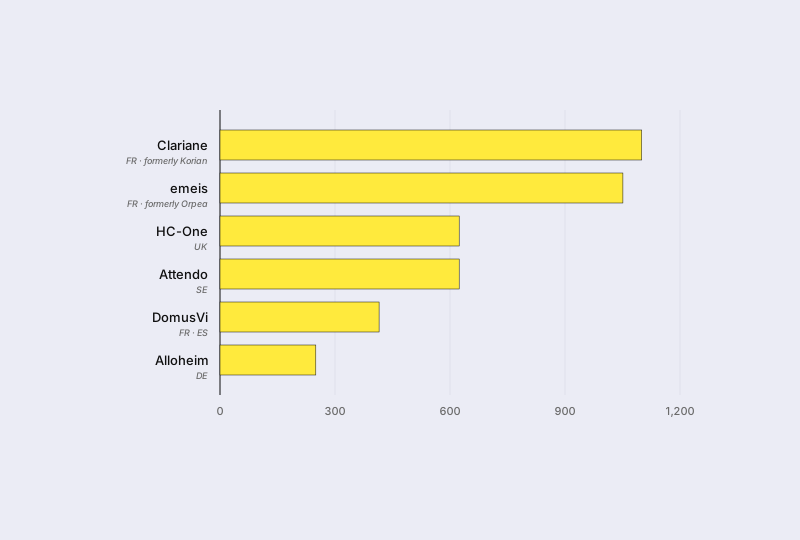
The pan-continental consolidation of senior living operators is the structural change that has most deeply shaped furniture specification over the past decade. Korian operates more than 1,100 facilities across seven European countries; emeis (formerly Orpea) reaches comparable scale. In North America, Brookdale Senior Living, Sunrise Senior Living, Atria Senior Living, and Holiday Retirement operate hundreds of facilities each, while UK chains including Bupa, HC-One, Care UK, and Anchor Hanover hold similarly aggregated portfolios. The consequence for furniture procurement is a shift from facility-level specification to two- to five-year framework agreements, under which preferred suppliers receive priority status for a defined furniture category across the operator's entire multi-site portfolio.
For architects and interior designers serving individual new-build or refurbishment projects, the decision space has narrowed. A practice planning for a Korian, Brookdale, or Bupa facility typically operates within a predefined manufacturer matrix negotiated at the operator's central procurement office. This has reduced the relative importance of the direct specifier-manufacturer relationship in senior living, compared with hospitality or workplace, and correspondingly elevated the procurement relationship with the operator chains. Care home architects with specification influence remain influential primarily in the remaining independent operators: faith-based providers, municipal homes, charitable foundations, and the few remaining family-owned premium operators that select furniture on a project-by-project basis rather than under framework contracts.
Convergence with hospitality design
At the premium end of senior living, the separation from hospitality furniture is dissolving. Tertianum in Switzerland, Augustinum in Germany, Sunrise Senior Living's premium tier in the US and UK, and Nordic premium operators such as Attendo Plus specify reception areas, restaurants, lounges, and increasingly resident rooms to standards that would not look out of place in a four- or five-star hotel. Furniture manufacturers from the hospitality world — Andreu World, Pedrali, Arper in outdoor categories, Magis and Moroso in lounge segments — find specification positions in these projects that the conventional care home market would not open to them.
The convergence has a technical precondition: care requirements — cleanability, bariatric capacity, fire classification — must be met within the hospitality-grade specification, typically through project-specific custom construction, sharpened upholstery specifications, and individual compliance documentation. The line between senior living and hospitality is therefore not erased, but it shifts. A manufacturer seeking specification in upper-premium senior living must speak the hospitality vocabulary; a hospitality manufacturer seeking access to the segment must document care compliance. The brands that have built this dual qualification are visibly present in the market — and they are the names that appear with increasing prominence in the featured-brand registers of architectural practices with care specialization.

Senior living furniture manufacturers at a glance
The overview below assembles a curated selection of 22 manufacturers, organized into four subsegments. Unlike workplace or hospitality, the senior living manufacturer landscape is smaller and more specialized: the British care specialists dominate the dementia-friendly upper tier, the DACH and Nordic manufacturers serve the institutional care chains through their care lines, and the North American market operates within its own structures — Kwalu, Mity-Lite, Resident Essentials, Falcon Products — that play only marginal roles in Europe as imported brands. Within each subsegment, the sequence reflects specification relevance rather than alphabetical order.
Specialized care manufacturers
Specialized care manufacturers serve institutional care exclusively and have engineered their product development from the outset around dementia-friendly design, bariatric requirements, and care home regulatory compliance. They are absent from the consumer market and hold only marginal positions in workplace or hospitality — a focus that defines their depth of specification in senior living.
Knightsbridge Furniture (Bradford, United Kingdom): Founded 1937, one of the internationally leading specialists for dementia and care-grade furniture. The portfolio covers lounge chairs, care chairs, hospice furniture, and dementia care unit furnishing, consistently documented to Stirling DSDC principles with LRV values supplied per upholstery sample. Strong position in NHS Continuing Care and in the major British care chains.
Shackletons (Dewsbury, United Kingdom): Founded 1959, a premium specialist for care seating in the upper segment of the British market. The portfolio focuses on high-quality lounge chairs and care chairs with lift assistance, frequently specified in premium care homes, hospices, and privately funded senior living.
Kwalu (New York, United States, with European distribution): Specialized in polymer-clad furniture programs for senior living and healthcare. The continuous polyurethane coating over the wood substructure delivers a cleanability robustness unmatched in the market — positioning Kwalu as a reference for care homes with elevated hygiene requirements.
Repose Furniture (Telford, United Kingdom): Specialist for clinically-therapeutic seating, with particular focus on care chairs with pressure-distributing cushions for immobile or bed-bound residents. Heavily specified in NHS Continuing Care and in specialized dementia facilities.
Drabert (Minden, Germany): German care specialist with a long tradition in the care chair segment, now part of the Sedus Stoll Group. The portfolio primarily addresses the German care home market with care chairs, lift chairs, and ergonomic seating for geriatric care.
Care lines of established contract brands
The second group consists of contract manufacturers whose primary business sits in workplace, education, or hospitality and who address the senior living segment through dedicated care lines. These manufacturers benefit from their specification familiarity in adjacent segments and deliver care home furniture with a visual language that the premium tier of senior living increasingly requires.
Wiesner-Hager (Altheim, Upper Austria): Workplace and education manufacturer with a dedicated care program. The care line covers care chairs, seating for common areas, and resident room furnishing — consistently in specification quality that addresses the DACH care home market convincingly.
Brunner (Rheinau, Germany): Conference and lounge seating manufacturer with a care program for care home common areas, day rooms, and entrance settings. Brunner positions itself as a bridge between classical care home furniture and hospitality vocabulary.
Casala (Culemborg, Netherlands): Dutch manufacturer with a focus on education, hospitality, and care. The care line includes stackable chairs for common areas, lounge furniture, and care chairs — Casala serves the intersection between senior living and community-oriented care concepts particularly densely in the Benelux countries.
Dauphin (Offenhausen, Bavaria): German seating manufacturer with a broad contract portfolio. The Dauphin HumanDesign Group addresses the care home segment through multiple brand families and supplies ergonomically documented seating for resident, staff, and visitor areas.
Kusch+Co (Hallenberg, Germany): Specialist for furniture in waiting areas, foyers, and public reception settings — specification fields directly relevant in care home entrance areas. Strong position in healthcare projects, with crossover into senior living.
Seating for nursing and dementia care
Seating is the most demanding category in care home furniture, because every requirement field converges in it: bariatric, dementia, fall prevention, cleanability, and fire safety. The following manufacturers have developed seating programs specified for institutional care — some as specialists, some as contract program manufacturers with strong senior living positioning.
Martela (Helsinki, Finland): Finnish workplace and education manufacturer with a dedicated senior living line. One of the dominant manufacturers in the Nordic institutional care segment, with programs that bring Nordic care design vocabulary into pan-European care projects.
Isku (Lahti, Finland): Finnish contract manufacturer with its own senior living division. The portfolio addresses institutional care across Scandinavia and increasingly central Europe, with programs that explicitly combine residential atmosphere with institutional fitness.
Allermuir (Lancashire, United Kingdom): British manufacturer of lounge and conference seating, part of the Senator Group. The portfolio overlaps with senior living specifications in entrance and common areas, where Allermuir's hospitality-adjacent visual register addresses the residentialization brief.
Keilhauer (Toronto, Canada): Canadian seating manufacturer with a dedicated healthcare and senior living line. In the North American market an established reference; in Europe increasingly specified in projects with North American investor structures.
Connection Seating (Huddersfield, United Kingdom): British seating manufacturer with programs for workplace, education, and care. The care line includes lounge chairs and lift chairs for British and continental European care projects.
Height-adjustable and accessibility solutions
Height-adjustable furniture and accessibility solutions form a subsegment that differs product-side and distribution-side from the seating world. The leading manufacturers come from Scandinavia, where the institutional engagement with accessibility in care has a longer history than in central Europe or North America.
Ropox (Næstved, Denmark): Danish specialist for height-adjustable kitchen, bathroom, and care solutions. The portfolio addresses care homes, rehabilitation facilities, and accessible housing with a depth that few European competitors match.
Pressalit (Ry, Denmark): Second Danish specialist in the segment, focused on height-adjustable bathroom and care systems. Pressalit has shaped the European care market for decades through ergonomically documented transfer and care systems.
Stiegelmeyer (Herford, Germany): German market leader in the care bed segment. Care beds are a specialist field beyond the classical furniture specification, but integral to resident room outfitting as part of the overall furnishing brief.
Hill-Rom (Chicago, United States, now part of Baxter International): Global manufacturer of care beds and patient handling systems, dominant in the North American senior living and skilled nursing market. The care bed programs complement the broader resident room furniture specification.
Complete senior living manufacturer database
The 22 manufacturers in this overview represent a curated selection from the more comprehensive furnomics directory. The complete database assembles every senior living-relevant manufacturer that furnomics maintains editorially — care specialists, care lines of established contract brands, and care bed manufacturers — and is accessible through the brand index.
The directory is filterable by subcategory (seating, care chairs, resident room furniture, bariatric, height-adjustable, care beds), by region of origin, and by manufacturer size. Each entry links to a detailed brand page with product portfolio, designer collaborations, distribution channels, and — where available — reference projects in the care sector.
Frequently asked questions about senior living furniture
What does senior living furniture cover?
Senior living furniture covers the furnishing of residential and partial-residential care facilities — nursing homes, care homes, assisted living, dementia care units, hospice settings, and adult day care. Specification addresses care chairs and seating for resident and common areas, tables and casegoods for dining and day rooms, resident room furnishing (wardrobe, bedside table, casegoods), care beds as a separate specialist segment, height-adjustable kitchen and bathroom furniture for accessibility, and entrance and reception furnishing increasingly specified to hospitality grade in the premium tier. The central requirement across all categories is the combination of care compliance — bariatric capacity, cleanability, fire safety, fall prevention — with a residential atmosphere that withdraws the institutional character of the setting.
What standards apply to care home furniture?
For care home furniture, EN 1021-1 (smoldering cigarette test) and EN 1021-2 (match flame test) apply in Europe as minimum standards for upholstered furniture, sharpened in the United Kingdom by BS 5852 Crib 5 and in France by NF P92-503 (M1/M2). In Germany, DIN 4102 B1 governs fire-retardant furnishing above defined facility sizes. In the United States, NFPA 260, NFPA 261, and California Technical Bulletin 117-2013 set the fire-safety regime, supplemented by state fire-marshal codes. For ergonomic specification, EN 1335 applies in workplace transfer and DIN 18040-2 governs accessibility (seat heights 18 to 19 inches, grip clearances, door widths). Infection-control guidance comes from the CDC, the UK Department of Health, and the Robert Koch Institute; fall-prevention frameworks come from CMS, NICE, and the German DNQP Expertenstandard. The compliance architecture is therefore composed of multiple norm families — a unified senior living standard does not exist.
What is dementia-friendly furniture?
Dementia-friendly furniture follows the principles codified by the Dementia Services Development Centre at the University of Stirling since the late 1990s as the Dementia Design Audit. The core requirements are operational: contrast values between seating and floor surface of at least 30 LRV-point differential (Light Reflectance Value), so that residents with impaired spatial perception can recognize seating; avoidance of reflective surfaces that may be misread as water; avoidance of patterns on upholstery and flooring that can be interpreted as obstacles; and furniture placement supporting wayfinding through sight-line continuity. British care manufacturers such as Knightsbridge Furniture, Shackletons, and Repose Furniture supply LRV values per upholstery sample as a standard data point. North American practice has converged on the same framework through the Eden Alternative and the Pioneer Network; in continental Europe, the Stirling principles remain the internationally recognized reference even where national audit frameworks have not been codified.
What distinguishes senior living furniture from consumer furniture?
Senior living furniture for institutional facilities differs from consumer furniture in four dimensions. Constructively, through bariatric seat loads up to 550 pounds (250 kg), removable covers washable at 60 to 95°C, seamless upholstery, and antimicrobial surface treatments that withstand surface disinfection. From the compliance side, through fire-safety classifications under BS 5852 Crib 5, NFPA 260, DIN 4102 B1, or EN 1021, plus fall-prevention documentation and accessibility certification under DIN 18040-2 or its national equivalents. From the distribution side, through exclusively project-based sales via architectural and care chain relationships, without retail or online channels. And commercially, through warranty cycles of ten to fifteen years with parts availability and refurbishment programs. Care chairs sold through consumer medical-supply channels — Devita and mc-seniorenprodukte in Germany, equivalents in other markets — serve individual buyers with insurance reimbursement codes and are not specified for institutional care.
Which manufacturers lead the senior living market?
Three manufacturer groups lead specification in senior living. Specialized care manufacturers — Knightsbridge Furniture, Shackletons, and Repose Furniture from the United Kingdom; Kwalu from the United States; Drabert from Germany — serve institutional care exclusively and set the benchmark in dementia-friendly and bariatric segments. Care lines of established contract brands — Wiesner-Hager (Austria), Brunner and Dauphin (Germany), Casala (Netherlands), Martela and Isku (Finland) — combine the specification language from workplace and education with care compliance and densely occupy the DACH and Nordic markets. In the height-adjustable and accessibility specialist segment, Ropox and Pressalit from Denmark lead; in the care bed segment, Stiegelmeyer and Hermann Bock from Germany, and Hill-Rom internationally. A detailed overview of all manufacturers is available through the furnomics directory.
How is senior living furniture procured?
Procurement of senior living furniture in the international market increasingly follows a doubled logic. Major pan-continental operator chains — Korian, emeis, Alloheim, Brookdale, Sunrise Senior Living, Bupa, HC-One — negotiate two- to five-year framework agreements with preferred suppliers per furniture category and across the entire multi-site portfolio. Furniture selection at facility level is therefore made within a predefined manufacturer matrix that the operator's central procurement department defines. Care home architects and interior designers retain specification influence primarily in the independent operators — faith-based providers, municipal homes, charitable foundations, and privately funded premium providers such as Augustinum and Tertianum, which select furniture on a project basis rather than under framework contracts. For manufacturers, distribution logic has therefore shifted from the direct specifier relationship to the procurement relationship with the operator chains.
What does bariatric mean in senior living furniture?
Bariatric in senior living furniture denotes the engineering of furniture for elevated seat loads and increased seat widths, derived from the medical term for obesity care. While the specification typical in the 2000s and 2010s addressed 290 to 330 pounds (130 to 150 kg) of seat load, the requirement in recent tenders has shifted toward 440 to 550 pounds (200 to 250 kg) — a consequence of rising obesity rates in the resident population, documented in the United States by the CDC and in Europe by national equivalents since the mid-2010s. Bariatric adaptation affects not only seat load but also seat width (21 to 24 inches rather than the 18.5-inch standard), frame construction, and lift assistance. Bariatric-capable furniture has shifted in senior living over the past five years from a specialty specification to a standard documented by every serious care manufacturer.
Related topics
Senior living is one chapter in a wider ecosystem that furnomics covers editorially. The central pillar article on contract furniture frames the market structure and the economic logic of the segment within which care home and nursing home furniture operate as a specification field in their own right — from the editorial perspective of the manufacturer landscape, solution types, and the specifier workflow.
The overlap between senior living and adjacent sectors is broader than the segment boundaries suggest. Specifiers in senior living regularly work with furniture from the clinical acute sector — covered editorially in the healthcare hub — and at the premium end of senior living, specifications converge with hospitality furniture, addressed in the hospitality hub. Administrative areas within care homes follow workplace specifications and are documented in the workplace hub.
Topic-level coverage — segment portraits, industry interviews, product features — is gathered in the furnomics insights section. Forthcoming coverage in the senior living segment includes a dedicated examination of dementia-friendly furniture specification under the Stirling DSDC framework, an analysis of regional care-home regulations across European jurisdictions, and an industry portrait of the British care furniture sector as the internationally leading market for dementia-appropriate furniture design.