Modular office furniture in the contract market


Modular office furniture in the contract market is not a trend category but a furniture genre with an unusually long half-life. The iconic systems — USM Haller (1965), Vitsœ 606 (1960), String (1949) — have been produced in identical module grammar for decades. A USM Haller component ordered in 2026 fits an element delivered in 1969. This module continuity is not a marketing claim but the actual B2B argument: specifiers do not buy a piece of furniture, they buy the guarantee that the system can still be reordered twenty years from now.
The market breaks down into three structurally separate worlds. The architectural classics (USM, Vitsœ, String, Montana, Interlübke) sell module grammar. The workplace full-range suppliers (Vitra, Steelcase, König+Neurath, Bene, Wilkhahn) sell bench systems as part of larger office programmes. The storage system specialists (Bisley, USM, Montana, Cubit) sell modular storage architecture. A fourth layer has emerged alongside them: D2C brands such as Tylko and Burrow, growing aggressively in the B2C market and suddenly ranking above the classics in B2B search results. This hub maps these four worlds, treats module continuity and repairability as specifier arguments, and charts the emerging secondary market for used USM Haller furniture, which now sustains an industry of its own.
What modular office furniture means in the contract market
Distinction: contract, residential B2C, drywall partition systems
The term "modular furniture system" is used across three structurally different markets whose specification logics are not comparable. Anyone planning for an office building, a hotel lobby or a coworking layout has to keep these three worlds cleanly separated, because the selection criteria differ fundamentally.
In the contract market, modular means: a system with a fixed module grammar, produced unchanged for decades, with binding reorder reliability, repairability and project-grade logistics. The key brands — USM, Vitsœ, String, Interlübke, Montana — do not sell an end product but a repeatable spatial principle. Module continuity is the actual selling point here, not the individual piece.
In the residential B2C segment, modular means: configurable in an online shop, delivered in four to eight weeks, with limited expandability after three to five years. D2C providers such as Tylko, Burrow and Floyd operate in this world — with modern configurator logic, clear design language and manageable price bands. Relevant to specifiers only as a market-development indicator, not as a specification option.
In the drywall and partition market, modular means: demountable wall systems from providers such as Lindner, Maars Living Walls, Feco, Strähle or DIRTT. This world overlaps with the furniture segment at a single point — the demountability argument vis-à-vis ESG-oriented clients — but remains technically (M&E integration, F30/F90 fire protection, Rw acoustic ratings) a separate market. Anyone looking for modular partition architecture will find it in the furnomics partitions hub.
Market and main players
There is no clean market-size estimate for "modular furniture systems" — the term cuts across office, storage and residential statistics. What can be said precisely: the classics cluster is concentrated. USM generates annual revenue of around 250 million Swiss francs with over 500 employees at a single site in Münsingen. Vitsœ produces in Royal Leamington Spa with fewer than 100 employees and sells in over 70 countries. String employs around 50 people in Sweden. Three family-run or family-led companies, three module systems, which together define the classics segment.
Alongside them, the market has two substantially larger clusters. The workplace full-range suppliers — Vitra, Steelcase, Haworth, König+Neurath, Bene, Wilkhahn, Sedus — carry modular bench systems as part of their programme but not as their brand core. Vitra Joyn, Steelcase Frame One, Bene PORTS, König+Neurath Talo.S are bench programmes whose module grammar is more tightly defined than that of the classics and remains tied to the respective manufacturer's office world.
The storage system specialists — Bisley, USM, Montana, Cubit by Mymito, C+P Möbelsysteme, raumplus, Mocoba, Stocubo — serve the storage market with their own module systems. Bisley has dominated the British locker and drawer segment since the 1950s, Cubit has established itself as a DACH configurator brand, raumplus builds modular wardrobe systems for the contract market.
Subcategories of modular systems
Within the hub term, four subcategories can be distinguished, which are applied consistently throughout this overview.
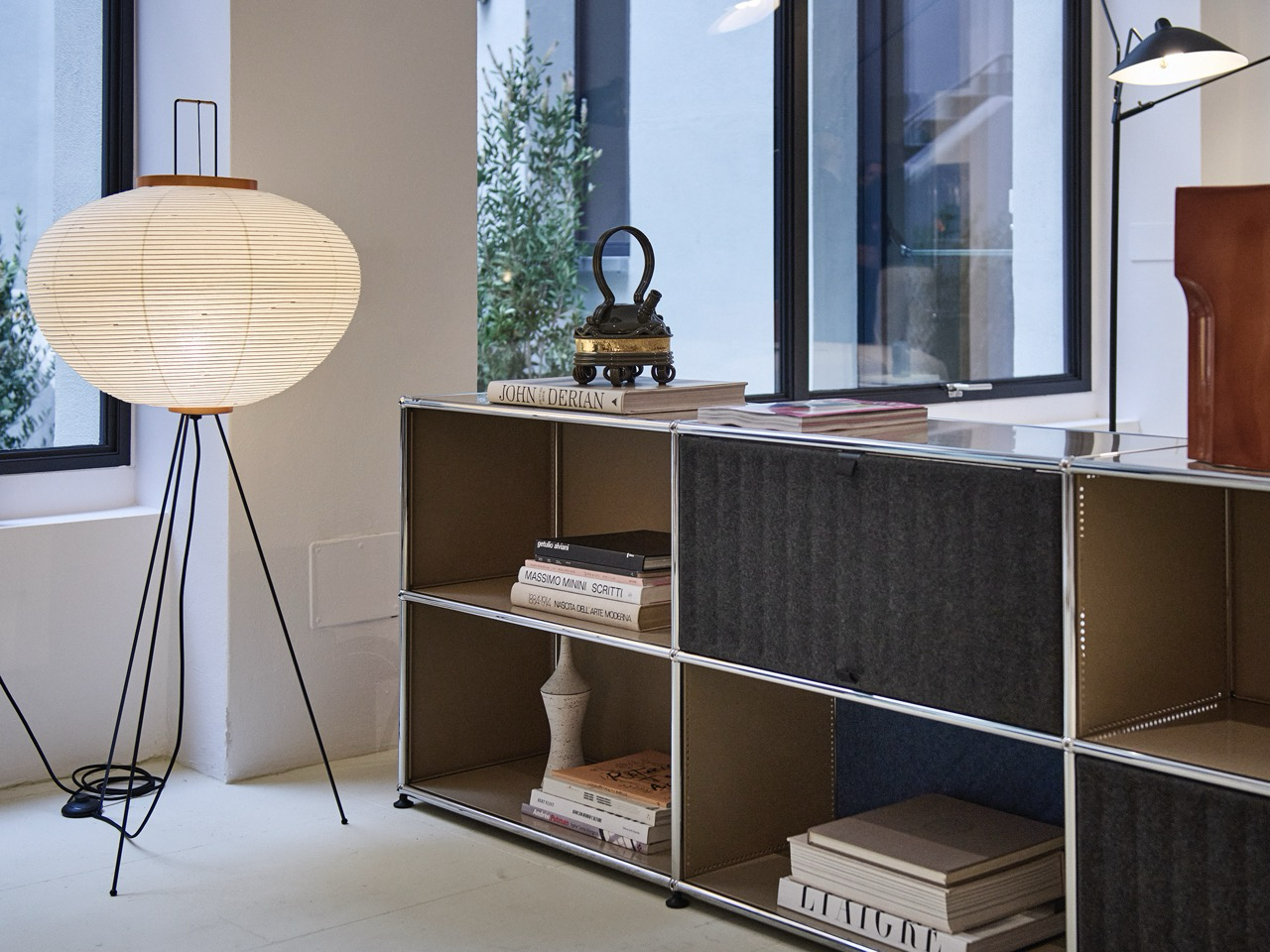
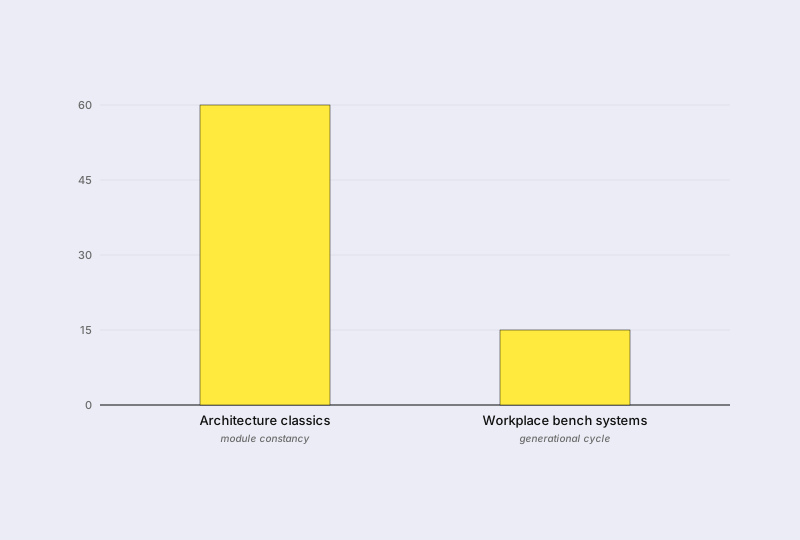
Modular cabinet systems are the narrowest classics segment: USM Haller, Vitsœ 606, String System, Interlübke Studimo, Montana Selection. A fixed grid grammar (USM Haller: 350-mm cube grid, Vitsœ: E-Track rail system) defines the system. Expansion happens by adding modules of the same generation. Lifespan: 30–60 years.
Modular workplace bench systems are desk systems with row- and group-capable workstation logic: Vitra Joyn, Steelcase Frame One, Bene PORTS, König+Neurath Talo.S, Haworth Compose. Module grammar is more tightly framed (desk height, row lengths, linkage logic) and product-generationally tied to the respective manufacturer's office world.
Modular storage systems are storage systems with cabinet logic: Bisley MultiDrawer, USM Haller Storage, Montana Selection, Cubit, C+P, raumplus. The boundary to the classics segment blurs here, since USM and Montana are at home in both worlds.
Modular D2C systems are the youngest layer: Tylko, Burrow, Floyd, Pastoe (with B2C line). Configurator-driven, with reduced module grammar and focused on the residential segment. In the contract market relevant only in project contexts with clear D2C character (apartment branding, coworking pop-up).

Requirements: module continuity, material quality, ESG
Module generations and reorder reliability
The central specification question for modular office furniture is not "What does the piece look like?" but "How old is the module generation, and how long will it remain in production?". When placing an order for a major project, specifiers calculate reorder risk over 15–30 years. A conference room with 40 modular cabinet elements that needs to be expanded by four elements eight years later can only be supplemented cleanly if the manufacturer keeps the module grammar in unchanged form.
With USM Haller, the decisive technical value lies in the 1965-patented construction with three basic elements — ball, tube, panel. This geometry has remained unchanged since the patent was granted. A cabinet delivered in 1969 can be expanded in 2026 with modules of identical geometry, without adapters. Vitsœ has pursued the same logic with the 606 Universal Shelving System since 1960 — the commitment consolidated under Mark Adams' takeover in 1995 reads, literally, "live better, with less, that lasts longer". String has kept its shelving system in production since 1949.
With workplace bench systems, the situation is different. Vitra Joyn (since 2002), Steelcase Frame One (since 2014) and Bene PORTS (more recent generation) operate in product generation cycles of 8–15 years. Expansion after a generation change is possible but not guaranteed. Specifiers managing multi-site rollouts have to factor the respective manufacturer's generation roadmap into their decision in order to avoid facing incompatible modules during the second wave.
Material quality and repairability
Modular furniture systems differ from conventional office furniture in the repairability of individual parts. With USM Haller, single panels, flaps or balls can be reordered separately and exchanged without specialised tools. With Vitsœ, the same service is organised through the in-house planning system — customers wanting to expand a shelf from the 1970s receive modules from the same production line.
Material choice is the decisive factor for lifespan. USM Haller uses powder-coated steel sheet and chrome-plated steel tubes — materials whose surface stability remains measurably intact even after 30 years of office use. Vitsœ combines aluminium E-Tracks with lacquered wooden shelves in consistently identical specification. String works with powder-coated steel ladders and MDF or solid-wood shelves that can be reordered individually.
With the storage system specialists, the technical situation is similar but service depth varies. Bisley offers spare parts and drawer mechanics through its aftermarket programme — a 1990s MultiDrawer can be kept in operation with current components. C+P Möbelsysteme and Cubit by Mymito provide repair services with limited depth, focused mainly on lock components and front panels.
Circular economy and secondary market
What is treated as an ESG marketing argument for classic office-chair programmes or desk systems — repairability, demountability, resale value — has been lived practice for modular furniture systems for decades. USM Haller, Vitsœ and String have established themselves as circular products without initially labelling them as such. This property is becoming increasingly central in the ESG argumentation toward clients with Cradle-to-Cradle ambitions.
USM has been Greenguard-certified since 2007. Cradle-to-Cradle certifications exist for USM Haller and USM Kitos. Vitsœ deliberately abstains from product certifications and pursues instead the argumentative strand of lifelong expandability — a shelf that lasts fifty years is the more efficient answer to circular economy than a certified piece with a ten-year lifespan.
This structural circular economy has created a second-order market. The secondary market for used USM Haller furniture professionalised during the 2010s and today sustains an industry of its own with specialised refurbishers. This secondary market is treated separately in chapter C1.

Current market developments
Refurbished and secondary market
The resale market for used USM Haller furniture has evolved from an insider phenomenon into an industry of its own. Specialised refurbishers buy decommissioned stock from office relocations, dismantle the modules into individual parts, clean powder coatings and chrome plating, replace damaged flaps, and sell the material graded by condition class. The logic only works because the module grammar has remained unchanged since 1965 — a used module from 1985 can be combined seamlessly with new modules.
Several refurbishers have established themselves in the German-speaking market. Sumsum, Sebworld, Solutionpool, DKW Berlin, Noto Online and blucom run online shops with refurbished USM Haller stock, in some cases with warranty cover and delivery commitments of 14–28 days. Price bands typically sit at 40–70 percent of the new price, and above for rare colour variants (cream white, ruby red). The market is growing because original buyers from the 1980s and 1990s are now divesting their holdings — a USM wave that will continue for another one to two decades.
For specifiers, this secondary market opens a dedicated specification option that is becoming increasingly relevant in ESG argumentation. Refurbished USM in coworking layouts, start-up offices and hospitality projects is not a compromise but a deliberate statement — visible refusal of new purchase with unchanged module grammar and full expandability through new stock. Vitsœ and String have developed comparable but smaller secondary markets, primarily through marketplaces such as 1stDibs, Pamono and Whoppah.
Tylko, Burrow and the D2C wave
Since roughly 2015, a fourth layer has emerged in the market: digitally native D2C brands selling modular furniture through online configurators, B2C logistics and aggressive performance marketing. Tylko (Warsaw, founded 2015) and Burrow (New York, founded 2016) are the most visible representatives; Floyd, Bisley Home (the B2C line of the British storage specialist) and Pastoe's B2C programme belong in the same category.
Tylko has become the European reference brand of the movement. The range consists of shelving systems with configurable geometry that the buyer assembles in a 3D configurator. The module grammar is considerably freer than at USM Haller or Vitsœ — almost any size combination is configurable — but, in return, less serially reorderable. Anyone wanting to expand a Tylko shelf five years later may find the exact colour no longer available. Burrow operates with the same model for sofas and sideboards in the US market.
For the contract market, these brands have so far been relevant only selectively. Branded apartments, coworking pop-ups and smaller hospitality projects with a clear D2C aesthetic occasionally draw on Tylko or Burrow. In classic specifier projects — corporate headquarters, government buildings, large hotels — they play no role. What they do achieve, however, is a shift in search behaviour. In Google search results for "modular furniture systems", Burrow has ranked at position one in the US for years, above USM, Steelcase and the entire classics segment.
ESG and demountability as specifier argument
Module continuity, repairability and resale value can be bundled, from around 2022 onward, into an ESG argument toward clients who actively demand these properties. The triggers are the EU Taxonomy, CSRD reporting obligations and the forthcoming Ecodesign for Sustainable Products Regulation (ESPR), which is preparing, among other things, the Digital Product Passport. Modular furniture systems are among the few furniture categories that have met these requirements for decades without needing to adapt.
The line of argument is straightforward. Demountability — the ability to dismantle a piece without tools and reassemble it elsewhere — is structurally inherent in USM Haller and Vitsœ. Module continuity guarantees that the piece can be supplemented with modules of the same generation after a site change. Repairability reduces the need for full-piece replacement to single-component exchange. The secondary market means that at the end of the first-use cycle there is no disposal requirement but a resale option.
In specifier briefings for ESG-oriented projects, this combination has become an independent argumentation space. Anyone specifying modular furniture systems for office construction can present lifecycle costs and scope-3 climate impact structurally better than with conventional programmes. This property accounts for part of the recent USM Haller specification waves in certified office buildings (LEED Platinum, DGNB Gold) — the module grammar supplies the argumentative foundation automatically.

Modular office furniture manufacturers — overview
Architectural classics: USM Haller, Vitsœ, String
The classics layer of the modular furniture market consists of a small group of manufacturers whose systems have been produced in unchanged module grammar for decades. They define the segment through constructional rigour, generational recognisability and a service logic geared to lifecycles of 30 to 60 years.
USM from Münsingen is the dominant representative. The USM Haller system was developed in 1963 by Paul Schärer Jr. and architect Fritz Haller, patented in 1965, moved to series production in 1969 and added to the permanent collection of MoMA New York in 2001. Three basic elements — chrome-plated brass balls, chrome-plated steel tubes, powder-coated metal panels — can be combined and reorganised in any direction. Cradle-to-Cradle certifications exist for USM Haller and USM Kitos, Greenguard since 2007. Extensions include USM Haller E (wireless light and power integration) and USM Haller Lock C (electromechanical app locking). Reference projects: The Gherkin London, Fondation Louis Vuitton Paris (Frank Gehry).
Vitsœ is the second defining brand of the classics layer. Founded in 1959 in Frankfurt am Main as Vitsœ + Zapf by Niels Vitsœ and Otto Zapf, with Dieter Rams as designing partner. The 606 Universal Shelving System (1960) is the core product, complemented by the 620 Chair Programme (1962) and 621 Side Table (1962). Production has been concentrated in Royal Leamington Spa (England) since 1995, with sales running directly to the end customer through an in-house planning system. The 606 shelving system in the German Chancellery comes from the same module grammar as a shelf newly configured today. Vitsœ deliberately abstains from seasonal collections, discount campaigns and product certifications, basing its ESG argumentation on the structural longevity of the system.
String Furniture from Sweden has produced the String shelf since 1949, designed by architect Nils Strinning. The system is based on powder-coated steel ladders and hooked-in wooden shelves, complemented by desk elements, cabinets and display cases. String is the most accessible brand of the classics layer — price bands sit clearly below USM and Vitsœ — and has established itself broadly in recent years through architecture magazines, B2C online shops and specifier projects. The module grammar has remained unchanged in its core dimensions since 1949; extensions from current production can be combined with old stock.
Interlübke from Rheda-Wiedenbrück carries an independent classics line in the cabinet segment with the Studimo programme (designed 1973 by Rolf Heide). Studimo connects residential and office application in a modular logic that has been consistently developed further under new ownership (Joka Group). Montana from Denmark has produced the Selection system since 1982, with over forty configurable modules in more than fifty colour tones; the reach is broader than at USM or Vitsœ, with somewhat softer constructional rigour. Pastoe (UMS Pastoe) from the Netherlands has established a comparable position in the Dutch market with the Vision system and the A-Cabinet, though more recent product additions have drifted increasingly toward B2C.

Workplace full-range suppliers with bench systems
In the workplace cluster, the large full-range suppliers sell modular bench systems as part of their office programmes. The difference from the classics is structural: here, modularity is a product-feature argument, not a brand core. Bench programmes are developed further in product generation cycles and remain tied to the respective manufacturer's design language.
Vitra defines the formative bench system of this category with Joyn (Bouroullec, 2002). Joyn defines the workstation as a shared desk landscape with add-on elements for screens, storage and dividing panels. The system has been in production for over two decades and is present in specifier projects worldwide — from Apple Park to the German Bundestag. Vitra complements the bench programme with modular lounge systems such as Alcove (Bouroullec, 2006) and Soft Work (Edward Barber & Jay Osgerby), which function as retreat zones in open office landscapes.
Steelcase covers the bench segment with Frame One and Migration SE. Frame One (since 2014) is conceived as a desk platform for open office landscapes, Migration SE provides the height-adjustable version of the same construction principle. Steelcase positions the programme as part of broader office concepts (Steelcase Flex, Work Café solutions) and, since the HNI takeover in December 2025, has integrated the programmes of Allsteel and Orangebox into the same sales structure.
Haworth works with Compose and Belong as bench and workstation systems. Compose is designed as a platform for open layouts, Belong addresses the personalised single-workstation logic with modular storage elements. König+Neurath from Karben leads one of the most precise German bench constructions with Talo.S — height-adjustable, row-linkable, with integrated cable management. Bene serves the segment with PORTS, a modular system of storage, seating elements and desks intended to zone open office landscapes. Wilkhahn rounds out the spectrum with Travis and Confair for modular meeting and conference landscapes.
The second row of full-range suppliers is broadly populated. Sedus delivers modular bench programmes with se:lab and temptation, Assmann Büromöbel with Canvaro, Palmberg with Crew and Orga-Plus, Fantoni with Multiplo and Office. Mikomax Smart Office, Narbutas, Nowy Styl and Martela serve the Central European and Nordic markets with their own bench programmes in comparable construction logic. OFS, Quadrifoglio, Frezza and Estel Group from Italy and Bulo from Belgium complete the European spectrum.

Storage system specialists
The storage system specialists form the third structural cluster of the market. Modularity here is not a design gesture but storage architecture: drawer units, lockers, cabinet rows and container trolleys are sold as reproducible logistical components, with their own lock logic, service programmes and project-specific configurations.
Bisley from Newport (South Wales) is the reference manufacturer for British and Central European office storage. The MultiDrawer concept (in production since 1953, over two million units sold) is the iconic drawer architecture of the segment and received the Design Guild Mark from the Furniture Makers' Company in 2018. The current programme comprises pedestals, side filers, filing cabinets, lockers and tambour cupboards in steel, as well as the modular wood system BOB (Paul Kelley, 2019). BeSmart adds a networked locker architecture with app access and live occupancy display — a response to hybrid working environments with desk sharing.
USM appears twice in this layer: USM Haller is as present in the storage market as in the classics cabinet market, because the module system uses the same grammar from drawer to room divider. Montana delivers a comparable dual role from Danish design tradition with the Selection system. Cubit by Mymito from Berlin has established itself as a DACH configurator brand, with modular cabinet and shelving systems in over twenty colour tones and a project-grade online configurator logic. C+P Möbelsysteme from Breidenbach serves the locker and storage cabinet market with its own industrial steel production and specifier programmes for schools, government buildings and industrial sites.
In the cabinet system segment at the residential-to-contract crossover, raumplus from Berlin and Mocoba from southern Germany lead with their own module systems featuring sliding-door and built-in wall logic. Mocoba works with a cube system (33 × 33 × 33 cm base dimension) that can be expanded flexibly into room dividers, shelf walls and cabinet architectures. Stocubo from Berlin operates with comparable configurator logic and addresses primarily residential and home-office applications. Officine Tamborrino from Apulia brings Italian industrial design into the same segment, with lacquered steel furniture in modular construction. Manerba from Brescia complements the Italian spectrum with modular storage walls in the contract market.
At the boundary to the workplace cluster sit the storage systems of the large full-range suppliers: USM Kitos, Vitra Storage, Steelcase Universal Storage, Bene Storage. These lines are integrated into their respective office programmes and treated, in specification logic, less as independent module systems and more as components within larger workplace concepts. Anyone wanting to explore storage from the material perspective will find the complete market overview in the furnomics storage hub.

USM Haller alternatives compared
The search term "USM Haller alternative" has become an independent market category since the late 2010s. The background is the price band of the original — a four-tier USM Haller sideboard build sits at around 4,000–6,000 euros in basic configuration — and the demand for modular storage architecture outside that range. What the market files under "alternative" breaks down into three clearly distinguishable categories: design classics of equal standing with their own module grammar, price-attractive modular systems with similar aesthetics, and D2C configurators focused on the residential segment. This overview addresses the first two — D2C brands are treated separately in chapter C2.
Vitsœ 606 is the only alternative on equal footing. Anyone looking for a furniture system with the same generational module continuity, the same repairability and the same specifier maturity inevitably arrives at the 606 Universal Shelving System. The design language is different — Vitsœ works with wall-mounted E-Track rails, USM Haller with self-supporting cube grids — but the specification logic is nearly identical. Price bands sit somewhat below USM Haller, with clear advantages for pure shelving applications and less suitability for freestanding cabinet architectures. Vitsœ is the classics alternative for specifiers who find the visual hardness of the USM cube grid too industrial.
String System is the most accessible classics alternative. The Swedish system of powder-coated steel ladders and hooked-in wooden shelves has module continuity since 1949 — longer than USM Haller — and sits clearly below it in price band. The specification argument is different: where USM Haller argues through the repairability of individual sheet-steel modules, String argues through the expandability of a constructionally leaner system. For hospitality, coworking and smaller office projects with moderate budgets, String is the obvious choice. In corporate headquarters and representative reception areas, its presence remains too understated.
Montana Selection is the colour-intensive alternative. The Danish system offers over forty configurable modules in more than fifty colour tones and is constructionally softer than USM Haller — no continuous cube grid, but an open cabinet grammar with high variant diversity. Anyone looking for modular architecture with colour and residential character finds an independent answer at Montana. Repairability is not at the same level as USM Haller, the secondary market is more fragmented, and lifecycle rigour is somewhat lower.
Interlübke Studimo, System 180 and raumplus deliver the German alternatives. Studimo (Rolf Heide, 1973) moves constructionally between cabinet classic and residential segment, with a module grammar that remains in production but is communicated less rigorously. System 180 from Berlin builds on an aluminium profile system with configurable desks, shelves and screens — design-true, small-series-oriented, with specifier maturity in smaller architecture projects. raumplus from Berlin operates in the cabinet system segment with sliding-door and built-in wall logic and is the obvious alternative for USM applications in wardrobe-adjacent areas.
fischer-möbel.de and Modulnova lie outside the comparison space. Anyone encountering fischer-office or Modulnova in online search results for "USM Haller alternative" should know the brand context: fischer-möbel.de (not to be confused with the outdoor specialist Fischer Möbel) is an online furniture retailer without its own module system production. Modulnova from Friuli is at its core a kitchen brand with architectural ambition, whose modular logic sits in the residential and kitchen segment, not in the office module system market. Both appear in search results but are not structurally USM Haller alternatives.
Mocoba and Stocubo serve the B2C crossover. Both DACH brands work with cube systems that visually recall USM Haller but are constructionally located in the MDF and engineered-wood segment. Module grammar is more freely configurable, lifespan shorter, price frame around one-third to one-quarter of the USM original. For residential applications and small home-office projects they are functional alternatives; in the specifier context they play no role.
Anyone planning a project with modular storage architecture should make the selection along an axis that recurs throughout this hub: is it about module continuity over 30+ years and project-grade reorder reliability (then USM Haller, Vitsœ, String), about residential colour presence with modular logic (then Montana, Interlübke), about cabinet system applications in wardrobe-adjacent areas (then raumplus, Mocoba), or about a design-true small-series alternative from the Berlin architects' scene (then System 180). Tylko, Burrow and the D2C wave address none of these specification spaces.

Complete A–Z brand database
The following overview brings together the manufacturers of modular furniture systems covered in this hub — classics, workplace bench programmes, storage specialists and D2C brands in a single alphabetical list. Brands with profiles in the furnomics database are linked, additional manufacturers without profiles are listed by name.
- Allsteel
- Assmann Büromöbel
- Bene
- Bisley
- Bralco
- Bulo
- Burrow
- C+P Möbelsysteme
- Cubit by Mymito
- Estel Group
- Fantoni
- Floyd
- Frezza
- gumpo
- Haworth
- Interlübke
- König+Neurath
- Manerba
- Martela
- MDD
- Mikomax Smart Office
- Mocoba
- Modulnova
- Montana
- Narbutas
- Nowy Styl
- Ofifran
- OFS
- Officine Tamborrino
- Orangebox
- Palmberg
- Pastoe (UMS Pastoe)
- Quadrifoglio Group
- raumplus
- Sedus
- Sitland
- Steelcase
- Stocubo
- String Furniture
- System 180
- Tylko
- USM
- Vitra
- Vitsœ
- Wilkhahn
A complete overview of all brands in the contract market can be found in the furnomics main index of brands.

Frequently asked questions
What is a genuine alternative to USM Haller?
The only alternative on equal footing is Vitsœ with the 606 Universal Shelving System — comparable module continuity since 1960, comparable repairability, comparable specifier maturity, different design language. For more price-conscious projects, String Furniture is the obvious classics choice; for colour-intensive residential and hospitality applications, Montana Selection. German alternatives include Interlübke Studimo (cabinet system), System 180 (aluminium profile system) and raumplus (cabinet system). Mocoba, Stocubo and similar D2C cube systems sit constructionally below the specification level but serve as price-attractive alternatives for residential applications.
Is it worth buying used USM Haller furniture?
Refurbished USM Haller stock on the secondary market is fully compatible with new modules thanks to the module grammar unchanged since 1965. Price bands typically sit at 40–70 percent of the new price, and above for rare colour variants. Specialised refurbishers such as Sumsum, Sebworld, Solutionpool, DKW Berlin and Noto Online offer verified condition classes with warranty cover. For ESG-oriented projects, the secondary market is also an independent specification argument — visible refusal of new purchase with full module expandability.
Why are modular furniture systems so expensive?
The price bands of USM Haller, Vitsœ and similar classics systems result from a construction logic calculated for a 30- to 60-year lifespan — not for the initial purchase. Powder-coated steel sheet, chrome-plated brass balls and repair-grade lock and flap mechanics cost more in manufacturing than tensioned MDF or particle-board materials. The lifecycle perspective (Total Cost of Ownership) shifts the picture, however: a USM Haller sideboard expanded by four modules after twenty years is, per year of use, cheaper than two generations of conventional storage furniture.
What distinguishes Tylko from a classic modular furniture system?
Tylko and comparable D2C brands such as Burrow or Floyd work with online configurators that allow almost any size combination but do not guarantee serial reorderability of the same modules over ten or twenty years. Anyone expanding a Tylko shelf five years later may find the exact colour variant no longer available. Classic modular furniture systems — USM Haller, Vitsœ, String — forgo this configuration freedom in favour of unchanged module grammar over decades. Tylko is the right choice for one-off residential applications with design freedom; classic systems are the right choice for specifier projects with reorder reliability.
Which modular furniture systems meet ESG and ESPR requirements?
Classic modular furniture systems meet the core requirements of the EU Taxonomy, CSRD reporting obligations and the forthcoming Ecodesign for Sustainable Products Regulation (ESPR) constructionally and automatically: dismantlability without specialised tools, repairability at single-component level, generational expandability and an established secondary market. USM has been Greenguard-certified since 2007; Cradle-to-Cradle certifications exist for USM Haller and USM Kitos. Vitsœ deliberately abstains from product certifications and argues instead through structural longevity. Bench programmes of the workplace full-range suppliers (Vitra, Steelcase, König+Neurath) carry their own sustainability certifications, which, however, must be reproved with every product generation cycle of 8–15 years.
Related topics
Modular furniture systems are a cross-sectional topic touching several sectors and categories of the contract market. The following furnomics hubs explore individual aspects that this overview could only sketch.