Hospitality beds: Hästens, Auping, Magniflex
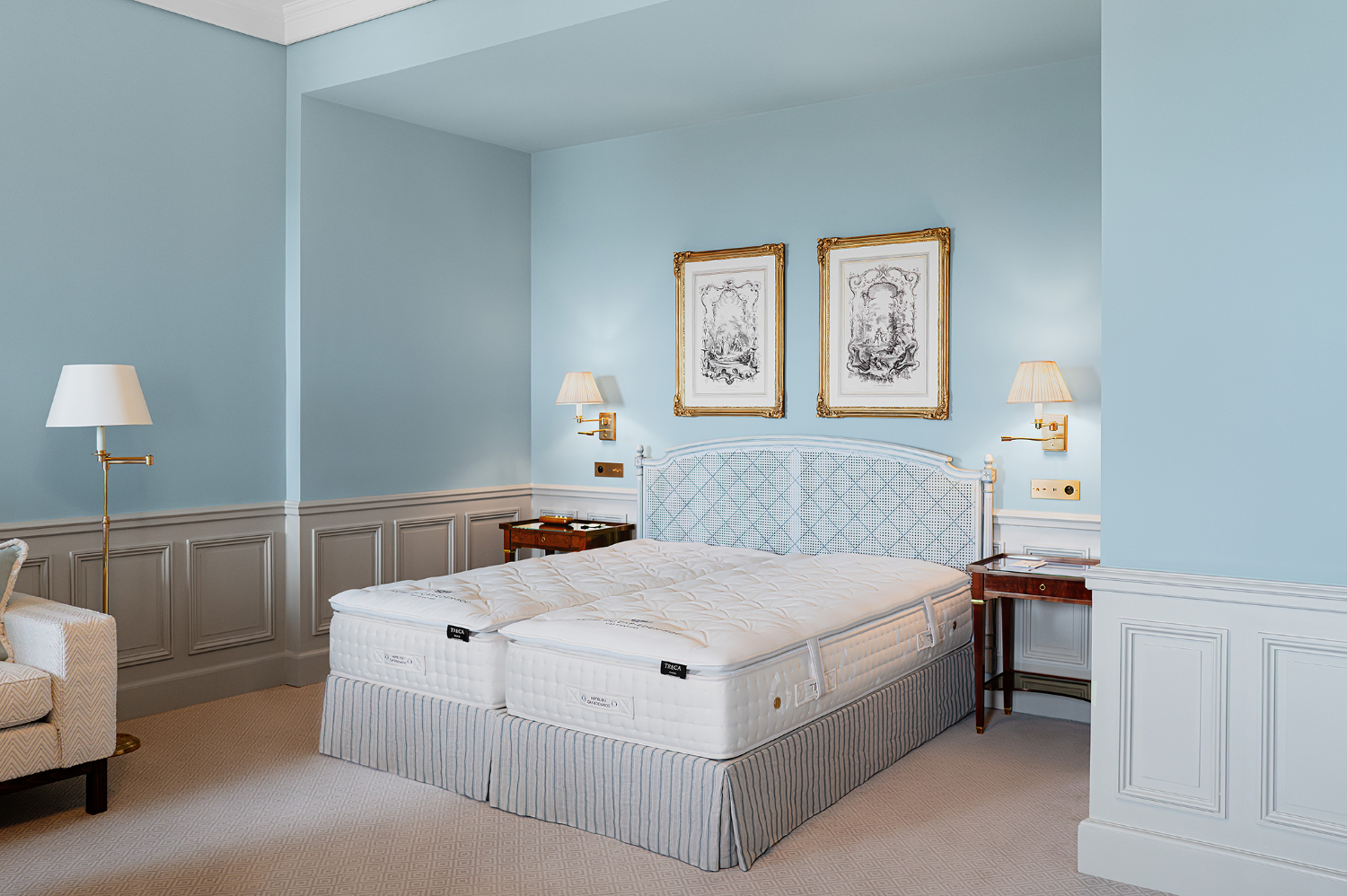
Tréca Paris has developed a bespoke sleep collection for the Hôtel du Cap-Eden-Roc in Antibes. The mattress, topper and base are part of the Riviera Collection and combine French craftsmanship with the requirements of luxury hospitality. Photo: Tréca

Hospitality beds are the invisible business card of every property: what the guest remembers after the first night shapes the review more than the lobby or the breakfast spread. The market for hotel beds is correspondingly segmented — from French boxspring manufactures such as Treca to Palatinate sleep-system specialists like Schramm, and on to global premium brands such as Hästens and Magniflex. Dutch hospitality programs from Auping and the contract lines of Italian upholstery houses round out the picture, serving hotel groups and boutique properties alike.
The logic of this market differs sharply from the private bedroom: in the contract sector, fire-safety standards, durability, project logistics and the resale value after five to seven years drive the specification. At the same time, the Westin Heavenly Bed has since 1999 set in motion a market dynamic that turned the hotel bed into its own brand category — from Hästens to Magniflex, premium manufacturers now sell systematically into both worlds. This hub maps the manufacturers that carry the contract sector, the requirements specifiers and planners need to address, and the dividing lines between hospitality, residential and care beds.
What hospitality beds mean in the contract market
Hospitality, residential and care beds compared
Hospitality beds in the contract sector are not simply more robust versions of private bedroom furniture, but a product category in their own right — with their own standards, their own logistics and their own distribution channels. The decisive difference lies not in material or comfort, both of which can be identical between private bedroom and hotel suite, but in the lifespan expectation under continuous occupancy turnover, in fire-safety requirements and in project-based procurement. While a private bed serves two to four people over ten to twenty years, a hotel calculates with 250 to 350 occupancy changes per bed annually and a reinvestment cycle of five to seven years.
Clearly distinct from the hospitality segment are care beds for hospitals, nursing homes and assisted living. These follow the medical-device logic of standard EN 60601-2-52, with electric height adjustment, integrated side rails and dementia concepts, and are handled by different manufacturers (Hermann Bock, Wissner-Bosserhoff, Stiegelmeyer, Völker) and different distribution channels (clinical procurement, medical technology). They are covered in the Senior Living hub. The overlap between hospitality and senior living emerges in hotels with barrier-free premium rooms and in service apartments, where hospitality beds are combined with added care components — a solution that nonetheless typically remains at the comfort-bed level rather than entering the medical care standard.
Within the hospitality segment itself there is a second, less visible dividing line: between classic hotel beds in single or double rooms and apartment beds in service apartments, long-stay accommodation and boarding houses. The latter often have to combine the functional density of a residential bed with the durability of a hotel bed — storage drawers, wall-mounted folding beds, modular components. This apartment line has gained disproportionate importance over recent years and belongs in any serious hospitality program.
Market and main players
The European hospitality-bed market is carried by three clearly contoured groups. The first is national premium manufactures: Schramm in the Palatinate, Treca in French Reichshoffen, Auping in Dutch Deventer, and Vispring in English Plymouth each serve a geographic home market with hospitality lines that grew out of their high-priced B2C programs. Schramm reports annual revenue of around 30 million euros (according to parent group Flex Equipos De Descanso), Auping around 60 to 65 million euros, while Treca and Vispring as family-held manufactures do not publish standalone figures. All four share a comparable business model: craft production at the headquarters, selective specialist-retail distribution, premium positioning with list prices starting at 5,000 euros for a double bed.
The second group consists of global sleep brands with their own hospitality programs: Hästens from Swedish Köping (founded 1852, sixth family generation, MoMA status, royal warrant to the Swedish court since 1952), Magniflex from Tuscany (founded 1962, exports to over 100 countries), and to a limited extent Tempur Sealy, which dominates the mass market of US hotel chains. These manufacturers operate in a different distribution logic: they sell identical product quality into hotels and into their own brand stores, which makes the cross-selling effect between hospitality experience and private follow-up purchase a strategic pillar.
The third group consists of mid-sized DACH boxspring full-range suppliers such as Maintal, Femira and various sleep-system specialists, who supply hotel chains and three- to four-star properties with standardized programs at volume. Their strength lies in delivery capability and standardization — 200 beds to identical specification, delivered and installed within eight to twelve weeks. They operate at list prices in the low four-digit range per bed and carry the volume business that the premium manufactures cannot or will not cover. Italian upholstery houses such as Flou and Milano Bedding complete the picture with textile-focused upholstered-bed programs, specified above all in boutique and lifestyle hotels.
Subcategories: boxspring, continental, modular
Three construction types have established themselves in the contract market, each of which entails its own specification logic. The boxspring bed is the dominant construction principle in hospitality: a sprung base supports a pocket-spring mattress, with a topper on top. This three-layer construction distributes load more evenly than a slatted-base system, enables high comfort differentiation through firmness variants of topper and mattress, and considerably simplifies maintenance — worn toppers are replaced after 24 months without dismantling the bed.
The continental bed is a further development of the boxspring logic, in which a second pocket-spring base mattress is added (two-mattress system). This construction is produced above all by Schramm, Treca and Hästens in their upper price segments and is considered the reference for highest comfort in a stationary bed. In the contract sector it remains restricted to suites and premium rooms; the additional construction depth (often more than 70 centimeters total height) requires higher ceilings and disqualifies the continental bed for standard categories.
The third subcategory consists of modular bed systems, deployed above all in service apartments, boarding houses and compact urban hotels. Solutions with integrated storage drawers, adjustable headboards or wall-mounted folding mechanisms dominate here. The target is floor-space optimization — an 18-square-meter urban hotel room with a 1.60-meter bed that functions as a seating landscape during the day requires a different construction logic from the classical 1.80-by-2.00-meter hotel sleeping surface. Italian manufacturers such as Flou and Milano Bedding have developed programs here that scale between boutique hotel and premium service apartment.

Requirements: durability, hygiene, specifier logistics
Durability and cleanability
The central requirement for hospitality beds follows from occupancy intensity: at average 70 percent occupancy, a hotel bed is used by around 250 different guests per year — over five years, that is 1,250 people of different weight, body type and sleep behavior. This stress cannot be compensated through thicker upholstery, but requires a systemic answer: high-resilience steel-spring constructions with guaranteed height recovery, removable and industrially washable covers, and modular component exchangeability that decouples wear parts (typically topper and covers) from the bed body.
Cleanability is steered through cover fabrics that withstand professional laundry logistics. Industrial washing cycle means 75 to 95 degrees Celsius, alkaline detergents and mechanical stress — conditions that would destroy many residential bedding textiles within months. Hospitality-grade covers are typically polyester-cotton blends or pure polyester microfiber with Martindale values from 40,000 cycles upward; the premium segment adds washable wool blends and coated natural fibers. Drying takes place in industrial tumblers, which additionally stresses the fiber structure and demands higher tear strength than is customary in private bedding.
A second, often underestimated factor is allergy suitability. Hotels increasingly position themselves with allergy rooms, which requires covers with mite-tightness (mite-barrier fabrics) and fully removable components. Wool fillings have an advantage here because wool naturally inhibits a mite-friendly environment while regulating temperature and moisture. Premium brands such as Hästens use this material advantage systematically and position their natural-material constructions as an answer to the growing allergy market in the hospitality segment.
Fire safety and upholstery standards
Fire safety is the non-negotiable specification basis in the hospitality sector. Cover fabrics and upholstery for hotel beds must in Germany pass at least DIN EN 1021-1 (cigarette ignition) and DIN EN 1021-2 (match flame) — the European minimum standard for upholstered furniture in the contract sector. In the UK, BS 5852 Crib 5 sets considerably stricter requirements, while the US has its own regime with CAL 117 and CFR 1633 (federal mattress standard since 2007). International hotel chains therefore frequently specify to the strictest regionally applicable standard in order to enable unified procurement across borders.
The fire-safety requirement entails significant material consequences. Standard foams are typically excluded; fire-retardant polyurethane foams, CMHR foams (Combustion Modified High Resilience) or, increasingly, wool-fiber nonwovens are used — the latter rendering chemical treatment unnecessary through their natural flame resistance. The wool route has gained importance in recent years because it bundles two strategic advantages: chemistry-free fire performance and sustainable material origin. However, wool is more expensive than treated foam, which shifts the choice into the premium segment.
Pocket-spring constructions are unproblematic from a fire-safety perspective, provided the surrounding upholstery meets the standard. Here lies an advantage of boxspring and continental construction over pure foam mattresses: the spring core itself is a steel component and not combustible, which concentrates the fire-safety task on toppers and covers — components that are routinely renewed as wear parts in any case. This separation of body and wear component considerably simplifies fire-safety logistics and is one of the reasons why boxspring constructions dominate the hospitality market.
Project logistics: volumes, installation, service
Hospitality procurement follows a logic that has nothing in common with single-unit sales in specialist bed retail. A mid-sized four-star property with 150 rooms needs 150 beds to identical specification, delivered in one or two waves, installed on site within a few weeks, and supplied with spare parts and topper replenishment over five to seven years. This requirement excludes most consumer-oriented manufacturers from the market — without a project-sales department handling specifier support, sample provision, delivery coordination and after-sales logistics, the contract sector cannot be served structurally.
The premium manufactures (Schramm, Treca, Auping, Vispring) solve this task through separate hospitality sales lines that are organizationally distinct from the B2C business. They work with longer delivery times of ten to sixteen weeks from order, but compensate through configuration depth and manufacture-level adaptability to individual architecture. Hästens operates with the "Hästens Hospitality" line a globally unified hotel program installed in over 30 countries; Magniflex exports to over 100 countries and delivers through local distribution partners.
The DACH boxspring full-range suppliers (Maintal, Femira and competitors) operate with shorter delivery times of six to ten weeks, lower configuration depth and standardized hotel programs held as catalog items. They carry the volume business in the three- and four-star segment and are often the first address for hotel groups equipping several properties simultaneously. Alongside price-performance ratio, the decisive factor here is reorderability: when individual beds need to be replaced after three years, the identical model must still be available — a requirement that many boutique manufacturers with their rotating collections cannot meet.

Current developments in the market
Heavenly Bed, Westin and the hotel branding wave
In August 1999, Westin Hotels & Resorts under then-Starwood chairman Barry Sternlicht introduced the Heavenly Bed — a ten-layer upholstered bed with white bedding, Simmons Beautyrest pocket-coil mattress, three down pillows and a down duvet. The bed replaced the floral coverlets that had dominated American hotellery for decades and defined the hotel bed as a product promise in its own right. Within the first week after launch, dozens of Westin guests called asking how they could buy the bed for their homes — a response that neither Westin nor manufacturing partner Simmons had anticipated.
In 2000, Westin began retail sales through in-room catalogues, becoming the first hotel company to sell its own branded collection to consumers. By 2012, the Heavenly program had generated 125 million US dollars in revenue and sold over 100,000 beds to private customers. Industry observers such as Bjorn Hanson of NYU retrospectively described the Heavenly Bed launch as one of the most influential brand decisions of the hotel industry in the past twenty years. The consequence: Marriott, Hilton, Four Seasons, Sofitel and other chains followed with their own bed programs, and the hotel bed became a brand category with its own supply chain, distribution channel and pricing logic.
For European premium manufactures, this development marked a strategic crossroads. Hästens began systematically using its hospitality business as brand extension in both directions: the hotel guest experiences the bed in the room and ideally becomes a retail customer at the Hästens store. Auping, Magniflex, Schramm and Treca followed this logic with their own hospitality lines that carry the B2C brand core into the contract business. The Heavenly Bed model thus became the blueprint for a business model that begins in the private bedroom as a purchase decision and continues in the hotel bed as brand communication — or vice versa.
Premium sleep as brand promise
The strategic upgrading of the hotel bed has led to an investment wave over the past two decades that goes far beyond the original Westin concept. Premium hotels and luxury resorts today actively communicate their bedding as a differentiator, with detailed descriptions of mattress construction, cover material and pillow selection on their websites. Platforms such as Tripadvisor and Booking evaluate sleep quality as an independent review category, which has considerably increased the economic pressure on bed specification: a single negative sleep comment in the main rating pulls measurable score deductions that in turn affect ranking position on booking platforms.
This logic has moved the hotel bed from procurement into brand management. At large hotel chains, bed specification is today a top-level decision — Marriott's "Marriott Bed", Hyatt's "Hyatt Grand Bed", Four Seasons' bed program and the Hilton "Serenity" line are globally unified and centrally procured, often with long-term framework contracts with one or two premium suppliers. For suppliers this means: anyone securing a framework contract with one of the global chains gains volume in the five-digit bed range per year — but must also be capable of delivering, installing and servicing worldwide.
In the boutique and lifestyle segment, the brand logic works differently: here the individual bed selection becomes part of the architectural language of the property, and the manufacturer's brand is occasionally even openly communicated ("Sleep on Hästens", "Boxspring by Treca"). For manufacturers such as Hästens, Treca, Auping and Schramm, such boutique references are communicatively valuable because they support premium positioning in the B2C market. Hospitality contract and marketing visibility enter into a direct relationship here.
ESG, materials and recyclable boxsprings
The ESG debate in the bedding industry revolves around two closely connected topics: material origin and end-of-life recovery. Both fields are particularly relevant in hospitality because the reinvestment cycles of five to seven years systematically generate high disposal volumes. According to the European Bedding Industry Association, around 30 million mattresses are discarded across Europe annually, and the vast majority of these mattresses end up in incinerators — a consequence of the complex material layering of foam, nonwoven, springs, adhesives and cover fabrics that makes manual separation economically unattractive.
The strategically most visible answer to this material-loss logic comes from Auping: in collaboration with DSM-Niaga, the company developed a fully circular mattress construction and brought the first industrially produced model for hospitality use (first customer: Landal GreenParks) to market in 2018. In May 2020 the consumer variant Auping Evolve followed — a mattress whose components (springs, polyester nonwoven, pocket-spring core) are connected without adhesive and can be fully returned to new mattress production after take-back. Auping announced its intention to convert the entire product portfolio to circular construction by 2030, and since 2024 operates a robotized production line in Deventer with a capacity of 150,000 circular mattresses per year.
In parallel, the EU Ecolabel for mattresses has established itself as a voluntary standard, defining requirements for absence of harmful substances, material origin and repairability. On the regulatory side, mandatory marking is on the horizon with the Ecodesign for Sustainable Products Regulation (ESPR) and the associated Digital Product Passport — though the precise application timing for the furniture and mattress category is still being clarified. For the hospitality sector, two requirements emerge: first, specification according to circular construction principles, and second, organization of take-back at end of life. Suppliers offering both — such as Auping with its Auping Take Back System launched in 2011 — gain a strategic head start over competitors who leave end-of-life to the hotel operator.

Manufacturers at a glance
DACH hospitality specialists
The first layer of hospitality bed manufacturers in the German-speaking market consists of three European premium manufactures that have developed their hospitality lines as extensions of their B2C premium programs. Geographically they are not concentrated in DACH in the narrow sense, but distributed across Germany, France and the Netherlands — yet all three serve the DACH hospitality market with their own sales organization, their own showrooms and their own specifier contacts in Munich, Hamburg, Berlin, Vienna and Zurich.
Schramm Werkstätten is the dominant German address in DACH. Founded in 1923 as an upholstery and saddlery workshop in Winnweiler in the Palatinate, the company manufactures boxspring and continental beds with around 185 employees in artisanal manufacture production. The hospitality line "SCHRAMM Hospitality Hotel Collection" runs as its own program track alongside the three B2C lines Origins, Purebeds and Grand Cru. In October 2022, Schramm was sold to Spanish Flex Equipos De Descanso — a strategically significant consolidation in the European premium segment, because Flex already owned the British brand Vispring and the US brand ES Kluft. As a result, three of the most important Western European premium bed brands have belonged to one Spanish parent group since 2022, without the brands surrendering their independent positions in the market.
Treca, with French origins in the 1920s and today headquartered in Reichshoffen in Alsace, is the second pillar. The company has shaped the term "sommeil cousu main" (hand-stitched sleep) for decades and works with a three-layer system of pocket-spring base mattress, pocket-spring top mattress and topper. In the DACH market, Treca is particularly present in luxury hotels and in luxury private households; the brand is distributed via the sister brand Treca Interiors Paris in residential retail and through separate hospitality contracts in the contract business. As with Schramm, the boxspring focus lies in the upper price segment with list prices starting at 5,000 euros for a double bed.
Auping is the third pillar and the only one of the three with an active furnomics profile. Founded in 1888 in Deventer by blacksmith Johannes Auping, who laid the foundation for the modern sprung bed with his invention of the woven wire base, Auping today is the largest independent Dutch bed manufacturer with around 273 employees and 60 to 65 million euros in revenue. The company holds the royal warrant ("Koninklijk"). Strategically, Auping has built up two differentiation lines: the hospitality program track with distribution through its own project-sales organization, and the circularity line, which since the Niaga joint venture and the Auping Evolve market launch in 2020 has made Auping the reference in sustainable mattress construction. Auping was the first bed company worldwide to sign the Cradle-to-Cradle Charter and has been B Corp certified since 2023.
In the hospitality sector, the three manufactures often appear as competing offers for the same project owner. Specifiers usually choose by three criteria: first, the brand position that should match the hotel architecture; second, the local service presence for maintenance and topper reordering; third, the delivery time, which in the premium segment regularly runs between ten and sixteen weeks. The three houses are closer in pricing than their B2C brand positions might suggest — competition usually decides on configuration depth, regional representation and reference projects on site.

Global premium brands
The second layer of hospitality bed manufacturers consists of three brands that sell globally beyond their home markets and thus follow a different logic from the continental European manufactures described in the previous section: they aim not for regional specifier proximity but for international brand presence that addresses both hotel chains and end consumers in 40 to 100 countries. These brands are represented in the DACH region through local distributors or own stores, and in the hospitality sector are typically specified when the global brand positioning of a property (luxury resort, international chain, premium boutique hotel) overrides the local manufacture argument.
Hästens is the most influential of the three brands in the premium segment. Founded in 1852 in Köping, Sweden, the company has been family-owned across six generations; CEO and fifth-generation owner is Jan Ryde. Hästens has been royal warrant holder to the Swedish court since 1952, and the famous Blue Check pattern is trademark-protected — a rare constellation in the furniture industry that shows how heavily visual brand codes are weighted in premium sleep furniture. Hästens employs around 340 people and is active in over 40 countries with more than 300 distribution partners. Reported revenue in 2016 was around 62 million euros with double-digit growth rates; more recent consolidated figures are not published by the family-held company. In April 2023, Hästens entered a strategic partnership with American MadaLuxe Group, which is to open 20 new stores in the United States over the following five to seven years — a notable push into a market dominated by Tempur Sealy and national providers.
Magniflex is the global Italian answer and follows a different logic. Founded in 1962 in Prato, Tuscany, by Giuliano Magni — the Magni family has been resident in Prato for over four centuries — the company focuses on foam and memory mattresses rather than the pocket-spring constructions of Hästens and Schramm. Magniflex is today the largest Italian mattress manufacturer with over 180 employees, exports around 80 percent of production to 99 countries and produces around 10,000 mattresses per day. According to its own figures, the company is present in over 500 hotels worldwide and is operationally led by Alessandro Magni (President and CEO) together with his brothers Fabrizio (development) and Marco (President Magniflex USA). The Magnistretch line is the only mattress product recognized by the American Chiropractic Association as orthopedically supportive — a differentiation argument that Magniflex deploys systematically in international hospitality specification.
Vispring is the third brand in the cluster and at the same time the link to its German sister brand Schramm: since the Schramm acquisition in 2022, Vispring and Schramm belong to the same parent group, Flex Equipos De Descanso. Founded in 1901 on London's Eagle Street, Vispring shaped modern premium bed construction through its licensing of the Marshall coil patents — the pocket-spring construction developed by James Marshall in Canada that today forms the technical basis of all high-quality boxspring and continental mattresses. The brand name "VI" stands for the Roman numeral six and references the six turns per coil that became its technical hallmark. Vispring has manufactured in Plymouth in southwest England since 1971; the brand reference list ranges from the RMS Queen Mary via the Titanic to contemporary premium hotels. In 2022, Vispring opened its first flagship store on Regent Street in London — a late but deliberate move into direct end-consumer communication.
In the DACH hospitality market, Hästens, Magniflex and Vispring compete less against Schramm and Treca than against different brand questions: Hästens carries the premium Scandinavian positioning, Magniflex the Italian lifestyle component, Vispring the British manufacture tradition. Hotels with a thematically clearly defined brand architecture — for example Scandinavian design, Italian lifestyle concept or British classicism — often choose directly by brand narrative. The geographic delivery logistics is organized through distributor structures for all three and can extend delivery times compared to the continental European manufactures; this is compensated for in the specification phase through early sampling and project-specific buffer times.

Boxspring full-range suppliers for contract
The third manufacturer layer in the hospitality bed market operates under a different business logic than the premium manufactures described in the previous sections. Here the question is not manual manufacture adaptation and brand architecture but supply capability at volume: standardized programs with calculable reorderability over five to seven years, shorter lead times between six and ten weeks, and list prices in the low four-digit range per bed. Three- and four-star properties, hotel chains with centrally managed procurement, and service-apartment operators are the main target groups — specifiers looking for standardized solutions because their properties are structurally dependent on repeatable, exchangeable constructions.
In the DACH region, Maintal Betten (founded 1969 in Lichtenfels in Upper Franconia, family-owned in the third generation), Femira and several mid-sized boxspring specialists are the most important providers in this segment. Maintal, for example, produces in its own German facilities with calculable delivery reliability and a broad configuration spectrum from Bonell through pocket-spring to luxury barrel-pocket-spring cores; the model lines are named Mykonos, Stockholm or Kopenhagen and are offered in the standard sizes 100/140/160/180/200 by 200 centimeters. Alongside, Brinkhaus Hospitality occupies the intersection of bed system and hotel bedding as a specialized provider with programs such as the "BOX 30" and comparable hotel-box constructions. These suppliers rarely appear in the architecture press but are strong in supplying hotel chains whose procurement is handled through central purchasing departments.
An independent subgroup in volume business consists of Italian upholstered-bed specialists, specified in lifestyle and boutique hospitality. Flou, founded in 1978 in Meda in the Italian furniture cluster of Brianza, developed with Vico Magistretti's "Nathalie" bed in 1978 the first Italian upholstered bed with fully removable cover — a constructive innovation that is today the industry standard for textile upholstered-bed design. Milano Bedding from northern Italian Lentate sul Seveso and Manifattura Falomo from Friuli round out the Italian upholstered-bed spectrum with different focal points between folding-bed functionality and craft mattress production. In the DACH hospitality market, these brands are deployed less by volume than the boxspring full-range suppliers, but specifically where a textile-oriented design language carries the architectural brief.
Strategically, the volume segment does not compete directly with the premium manufactures from the previous sections but with its own sublayer of bed wholesalers and hotel full-service outfitters such as Lusini, Schrammbeds Hospitality or Hotelier.de. These distribution platforms aggregate the programs of several manufacturers and offer hoteliers single-source procurement across the entire room inventory — from bed and bedding to bedside table. For the full-range suppliers in the bed sector this means: those who position themselves early in such hotel total-outfitter networks secure access to procurement decisions that would be organizationally too complex without the aggregator structures — making the same business model scalable that works in the premium segment through direct specifier relationships.

What mattress do hotels use?
The question "what mattress did I sleep on at the hotel, and where can I buy it?" is one of the most frequently searched queries around hotel beds and answers itself less simply than it appears at first glance. The reality: there is no "hotel bed" as a generic mattress category, but a finely graded logic by hotel class, hotel brand and geographic market. Anyone sleeping at a Hyatt Place in Chicago is likely lying on a Sealy construction; anyone overnighting at a Bayerischer Hof in Munich may rest on a Schramm continental bed; and anyone checking in at an Ace Hotel in Brooklyn may land on a system supplied by Avocado or a similar lifestyle provider.
In US hotel chains, the supplier structure is most transparently documented. Marriott has worked with Jamison Bedding since 1966 — a partnership now in its sixtieth year — as well as supplementally with Serta Simmons; the "Marriott Bed" is based on a soy-foam construction and is available to end consumers through the Marriott online shop. Hilton specifies its "Serenity Bed" through Serta, Hyatt uses predominantly Sealy for the "Hyatt Grand Bed", and Westin's "Heavenly Bed" has used Simmons Beautyrest pocketed-coil constructions since its introduction in 1999. Four Seasons operates its own bed program positioned in the premium segment, manufactured by different premium suppliers depending on location. Most of these bed programs are orderable for private customers through the respective hotel online shops and have established their own retail economy in the US.
In DACH hospitality, brand clarity is considerably less pronounced. Five-star properties and premium resorts typically specify Schramm, Hästens, Treca or Auping, often in the hospitality hotel line of the respective brand. The four-star volume category is dominated by DACH boxspring full-range suppliers such as Maintal, Femira or Brinkhaus Hospitality, without the bed appearing as a brand statement. Three-star and budget hotels work with regional suppliers or with programs from the Hilding Anders Group, whose Recticel, Eastborn or Bico brands carry the mass market of Central European hospitality. In all three segments, the rule holds: the mattress that a DACH guest sleeps on is with high probability a boxspring construction with pocket-spring topper, in the standard size 90 by 200 centimeters (single bed) or 180 by 200 centimeters (double bed).
Practically, the concrete bed brand in a hotel can be identified in three ways: first, through the reception desk — many properties pass on supplier information openly when asked, because the inquiry is interpreted as a quality signal. Second, through the label on the bed itself, usually attached laterally to the base mattress or to the boxspring body, identifying manufacturer, model and fire-safety class. Third, through the hotel website or the brand communication of the property — boutique and premium hotels increasingly name their bed suppliers actively as a differentiation feature. Anyone planning a bed purchase for home should clarify before deciding whether the hotel bed model is constructed identically in its consumer-available variant or whether it is a specifically adapted hospitality version — the two versions often differ in fire-safety treatment, height and cover quality.

Complete brand A–Z directory
This overview gathers the most important manufacturers in the hospitality bed market from A to Z. Linked brands have an editorially maintained profile in the furnomics brand directory; brands named without links are documented but do not yet have their own profile. Care-bed manufacturers such as Hermann Bock, Stiegelmeyer, Wissner-Bosserhoff and Völker belong to the Senior Living sector.
Aireloom — US premium manufacturer from Rancho Cucamonga, California, handcrafted since 1940. Aquinos Group — Portuguese group from Sinde-Tábua, founded 1985, one of the largest European mattress and upholstery manufacturers; acquired the entire Recticel Bedding division in 2022, with brands including Schlaraffia, Lattoflex, Sembella, Swissflex, Bultex, Beka and Superba. Auping — Dutch premium manufacturer from Deventer, founded 1888, pioneer of circular mattresses, holder of the Dutch royal warrant. Avocado Green Mattress — US direct-to-consumer brand for sustainable mattresses from natural latex and organic wool.
Beka — Belgian mattress and boxspring brand, part of the Aquinos Group since 2022. Bico — Swiss premium brand, founded 1861, market leader in the Swiss bed market with over 80 percent brand awareness; part of the Hilding Anders Group since 2001. Brinkhaus Hospitality — German specialist for hotel bed systems and hotel bedding, headquartered in the Münsterland region. Bultex (Literie Bultex) — French mattress ingredient brand, part of the Aquinos Group since 2022.
Carpe Diem Beds — Swedish premium brand from Halmstad, founded 1973, manufacture-grade pocket-spring construction, part of the Hilding Anders Group. Continental Sleep — US boxspring brand in the mid-price segment. Curem — Swedish sleep-system brand, part of the Hilding Anders Group.
Dux Beds (DUX) — Swedish premium manufacture from Trelleborg, founded 1926 as Dux Industrier, known for the Pascal pocket-spring system; independent, not part of a larger group.
Eastborn — Dutch bed brand from Vroomshoop, founded 1959, part of the Hilding Anders Group since 2001 (full acquisition in 2007). ES Kluft — US premium manufacture from Rancho Cucamonga, California, part of Spanish Flex Equipos De Descanso.
Femira — German boxspring full-range supplier in the volume business. Fennobed — boxspring provider with a Finnish brand promise, distributed through German specialist retail partners. Flou — Italian upholstered-bed brand from Meda, founded 1978, innovator of the removable cover.
Hästens — Swedish premium manufacture from Köping, founded 1852, family-owned across six generations, royal warrant holder to the Swedish court. Hilding Anders Group — Swedish multi-brand group headquartered in Malmö, KKR portfolio company; brand portfolio includes Askona (Russia), Bico (Switzerland), Carpe Diem Beds (Sweden), Curem (Sweden), Eastborn (Netherlands), Hilding (Sweden), Jensen (Norway), Pullman (Netherlands), Slumberland (UK/Asia) and Vono (Asia); one of the largest European bed manufacturers with around 5,000 to 10,000 employees worldwide. Hypnos — British manufacture from Buckinghamshire, founded 1904, royal warrant holder to the British court.
Jamison Bedding — US manufacture from Nashville, founded 1883, main supplier to Marriott hotels since 1966. Jensen — Norwegian premium brand from Svelvik on the Oslo Fjord, leading bed brand in Scandinavia; part of the Hilding Anders Group since 2004.
Lattoflex — German sleep-system brand from Sankt Augustin, known above all for slatted-base constructions and bed systems; part of the Aquinos Group since 2022.
Magniflex — Italian mattress manufacturer from Prato in Tuscany, founded 1962, exports to 99 countries. Maintal Betten — German boxspring full-range supplier from Lichtenfels in Upper Franconia, founded 1969, family-owned in the third generation. Manifattura Falomo — Italian mattress manufacture from Friuli with craft pocket-spring production. Milano Bedding — Italian upholstered-bed manufacturer from Lentate sul Seveso with focus on folding-bed functionality.
Naturalmat — British manufacture from Devon, founded 1999, natural latex and wool mattresses for the premium segment.
Pullman — Dutch boxspring and mattress brand from Vroomshoop, since 1937, part of the Hilding Anders Group since 2007.
Savoir Beds — British luxury manufacture from London, founded 1905 (originally as the bed workshop of the Savoy Hotel), handcrafted continental beds in the premium segment. Schlaraffia — German bed brand with a long DACH tradition, part of the Aquinos Group since 2022. Schramm Werkstätten — German premium manufacture from Winnweiler in the Palatinate, founded 1923, since October 2022 part of Spanish Flex Equipos De Descanso. Sealy — US mattress brand, part of Tempur Sealy International, main supplier to Hyatt. Sembella — Austrian mattress brand, part of the Aquinos Group since 2022. Serta — US mattress brand, part of Serta Simmons Bedding, main supplier to Hilton. Simmons Beautyrest — US mattress brand, part of Serta Simmons Bedding, supplier to Westin and Marriott. Slumberland — British brand (founded 1919 by John Seccombe), today operating primarily in Asia; part of the Hilding Anders Group. Superba — French mattress brand, part of the Aquinos Group since 2022. Swissflex — Swiss premium bed-system brand, part of the Aquinos Group since 2022.
Tempur (Tempur-Pedic) — US-Danish brand for viscoelastic foam mattresses, part of Tempur Sealy International. Tempur Sealy International — US bedding group, world's largest mattress manufacturer by revenue. Treca Interiors Paris (Treca) — French premium manufacture from Reichshoffen in Alsace, founded in the 1920s, coined the term "sommeil cousu main".
Vispring — British premium manufacture from Plymouth, founded 1901 in London, licensee of the Marshall coil patent, part of Spanish Flex Equipos De Descanso. Vono — Asian bed brand, part of the Hilding Anders Group.
The A–Z directory is continuously updated editorially. Manufacturers not yet listed here or wishing to update their entry can reach out through the contact form.

Frequently asked questions
What mattress did I sleep on at the hotel, and where can I buy it?
The answer depends on hotel class and brand. In US chains, the supplier structure is most transparent: Marriott works with Jamison Bedding and Serta Simmons, Hilton with Serta, Hyatt with Sealy, Westin since 1999 with Simmons Beautyrest. Most of these bed programs are available directly to private customers through the online shops of the respective hotel chains. In DACH hospitality, the bed brand is less often openly communicated; premium properties usually specify Schramm, Hästens, Treca or Auping, while four-star properties often work with Maintal, Femira or Brinkhaus Hospitality. The fastest way to obtain the information is through the reception desk or via the label on the bed itself, usually attached laterally to the boxspring body.
What distinguishes a hospitality bed from a normal residential bed?
Three things: fire safety, durability and maintenance logistics. Hospitality beds must meet at least the European upholstered-furniture fire safety standards DIN EN 1021-1 and DIN EN 1021-2, in the UK the stricter BS 5852 Crib 5, in the US CAL 117 and CFR 1633. Cover fabrics are constructed to withstand industrial washing cycles at 75 to 95 degrees Celsius — typically polyester-cotton blends or microfiber with Martindale values from 40,000 cycles upward. Third, hospitality constructions systematically separate wear parts (topper, covers) from the bed body, so the topper can be replaced after 24 months without dismantling the bed. These three properties raise acquisition costs but extend the usable lifespan in hotel operation to five to seven years.
Why are premium hotel beds from Hästens, Schramm or Treca so expensive?
The price reflects three factors: manual production with sometimes more than 100 working hours per bed, natural materials such as unbleached cotton, virgin wool, horsehair and at the top end cashmere or alpaca fleece, and the circular logic of high-quality pocket-spring constructions that remain usable for twenty to thirty years. A Schramm continental bed from the Grand Cru line can cost between 8,000 and 20,000 euros depending on configuration; a Hästens top model such as the 2000T considerably more. In the hospitality sector, per-bed prices are lower than in the B2C business because the hospitality lines use essential-focused constructions with hospitality-specific cover fabrics — but they still lie well above the volume boxspring programs. Specifiers usually choose premium hotel beds when the bed-experience quality is part of the brand communication of the property.
Do care beds belong to the same market segment?
No. Care beds for hospitals, nursing homes, assisted living and dementia concepts follow the medical-device standard EN 60601-2-52, with electric height adjustment, integrated side rails and partly patient lift systems. They are produced by specialized manufacturers such as Hermann Bock, Stiegelmeyer, Wissner-Bosserhoff and Völker and distributed through clinical procurement and medical-technology channels — not through the hospitality procurement network. An overlap arises at hotels with barrier-free premium rooms and at service apartments for seniors, where comfort beds from the hospitality segment are supplemented with added care components. The detailed market structure of care bed manufacturers is covered in the Senior Living sector.
What role do ESG and circular economy play in the hospitality bed market?
A growing one, driven by two factors: the high disposal volume — around 30 million mattresses are discarded across Europe annually — and the foreseeable regulatory pressure through the EU Ecodesign for Sustainable Products Regulation (ESPR) and the Digital Product Passport, whose precise application timing for the furniture and mattress category is still being clarified. Auping brought the first fully circular consumer mattress to market with the Auping Evolve line in 2020 and built a take-back system that organizes end-of-life return. For specifiers, two requirements emerge: construction principles that enable material separation, and suppliers that offer end-of-life management. Premium manufactures with natural-material constructions such as Hästens and Schramm are systemically advantaged through their material mix; aggregator-driven volume providers still need to develop the circular logic.
Related topics
The hospitality bed market is closely interlinked with further topic areas in the contract business. The following hubs and sector overviews complement the view on hotel beds with adjacent market structures.
- Hospitality sector — Overarching market structure of hospitality furnishing, from lobby and restaurant via conference areas to room inventory.
- Senior Living sector — Care beds, assisted living and barrier-free furnishing with manufacturers such as Hermann Bock, Stiegelmeyer, Wissner-Bosserhoff and Völker.
- Residential Projects — Branded residences, service apartments and long-stay accommodation, where hospitality beds are combined with residential-bed functionality.
- Scandinavian Design — Design school and brand culture of Hästens, Auping, Carpe Diem Beds, Jensen and further Scandinavian bed brands.
- Italian Design — Italian upholstered-bed tradition with Flou, Milano Bedding, Manifattura Falomo and Magniflex.
- German Design — German manufacture tradition in bed construction with Schramm, Schlaraffia, Lattoflex and further DACH specialists.