

Okamura is moving digital transformation up the hierarchy. Yujiro Urakami will become Executive Officer and Chief Digital & Information Officer on July 1, 2026. The board approved the appointment on June 24. It sounds like IT. It is more than that.
For Okamura, the issue is no longer just whether servers run smoothly and systems talk to each other. The Japanese office furniture and workplace specialist faces a question many manufacturers will recognise: how do furniture, space, planning, data and service become a business model that still works tomorrow?
Urakami comes from the group’s IT strategy organisation. That is not a minor detail. Okamura is not bringing in an outside digital guru who first needs to explain that the future is somehow digital. That lesson has probably reached Yokohama already. Instead, the company is promoting someone from within, someone who should know the systems, processes and internal construction sites. Advantage: less slide-deck theatre. Disadvantage: fewer excuses.
The timing fits. Okamura closed fiscal 2025/26 with record figures. Revenue rose to 329.0 billion yen, operating income to 24.1 billion yen. The office business did most of the heavy lifting. Sales in that segment climbed 14.6 percent to 191.9 billion yen, while operating income rose 30.3 percent to 22.6 billion yen.
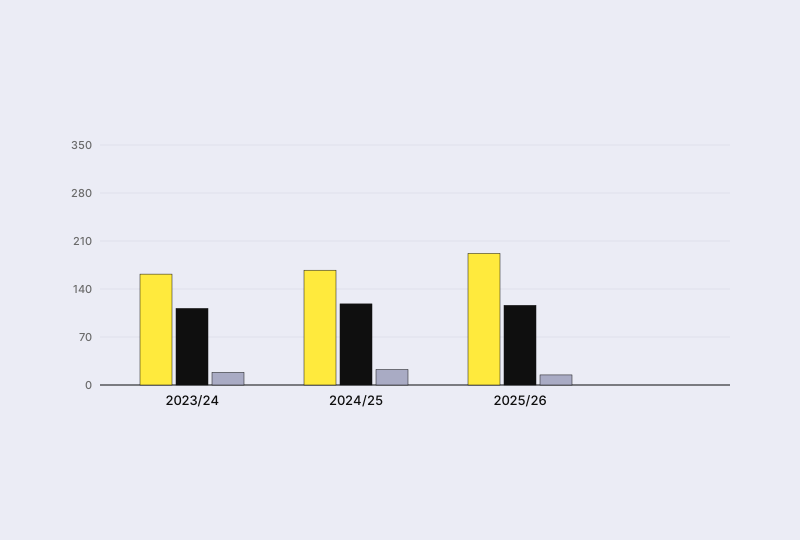
One could say: things are going well. That is usually when it becomes dangerous. While office is strong, other segments show that not everything flies on its own. The logistics systems business came under heavy pressure and slipped into an operating loss. Store Displays also struggled with lower volumes, higher personnel costs and relocation expenses.
Okamura is therefore in one of those pleasant corporate situations in which a company reports records and receives homework at the same time. The classic office business is performing. But the future will not be decided by chairs, tables and storage alone. It will be decided by how intelligently manufacturers connect their offers, roll them out internationally and translate them into digital processes.
On the DX side, Okamura names five priorities: Business DX, Operational DX, Management DX, human capital development and strengthening the system platform. That sounds very corporate. Perhaps it has to. More interesting are the concrete applications behind it: Work x D in the office business, OSCOM CLOUD for Store Displays and PROGRESS ONE for logistics automation.
This is where the appointment becomes interesting. Digitalisation at Okamura is no longer only an efficiency topic. It becomes the connecting tissue between furniture, space, retail, project business and service. Anyone working in contract furniture knows the problem: the most beautiful chair helps only so much if data, planning, delivery, tracking and operation do not fit together cleanly.

Ad


Okamura is moving digital transformation up the hierarchy. Yujiro Urakami will become Executive Officer and Chief Digital & Information Officer on July 1, 2026. The board approved the appointment on June 24. It sounds like IT. It is more than that.
For Okamura, the issue is no longer just whether servers run smoothly and systems talk to each other. The Japanese office furniture and workplace specialist faces a question many manufacturers will recognise: how do furniture, space, planning, data and service become a business model that still works tomorrow?
Urakami comes from the group’s IT strategy organisation. That is not a minor detail. Okamura is not bringing in an outside digital guru who first needs to explain that the future is somehow digital. That lesson has probably reached Yokohama already. Instead, the company is promoting someone from within, someone who should know the systems, processes and internal construction sites. Advantage: less slide-deck theatre. Disadvantage: fewer excuses.
The timing fits. Okamura closed fiscal 2025/26 with record figures. Revenue rose to 329.0 billion yen, operating income to 24.1 billion yen. The office business did most of the heavy lifting. Sales in that segment climbed 14.6 percent to 191.9 billion yen, while operating income rose 30.3 percent to 22.6 billion yen.
One could say: things are going well. That is usually when it becomes dangerous. While office is strong, other segments show that not everything flies on its own. The logistics systems business came under heavy pressure and slipped into an operating loss. Store Displays also struggled with lower volumes, higher personnel costs and relocation expenses.
Okamura is therefore in one of those pleasant corporate situations in which a company reports records and receives homework at the same time. The classic office business is performing. But the future will not be decided by chairs, tables and storage alone. It will be decided by how intelligently manufacturers connect their offers, roll them out internationally and translate them into digital processes.
On the DX side, Okamura names five priorities: Business DX, Operational DX, Management DX, human capital development and strengthening the system platform. That sounds very corporate. Perhaps it has to. More interesting are the concrete applications behind it: Work x D in the office business, OSCOM CLOUD for Store Displays and PROGRESS ONE for logistics automation.
This is where the appointment becomes interesting. Digitalisation at Okamura is no longer only an efficiency topic. It becomes the connecting tissue between furniture, space, retail, project business and service. Anyone working in contract furniture knows the problem: the most beautiful chair helps only so much if data, planning, delivery, tracking and operation do not fit together cleanly.