70 billion dollars. Or 180 billion. In between lie 110 billion dollars and a rather astonishing gap in knowledge. The international contract furniture market is a multi-billion-dollar business whose size nobody seems to know with any precision. furnomics has examined the figures – and found a few peculiarities of an industry that is larger than its digital presence would suggest.
Anyone wanting to know how big the global contract furniture market is needs one thing above all: a willingness to live with very different answers.
Global Market Insights puts the business at around 70 billion US dollars for 2025, Grand View Research at 78 billion. Fortune Business Insights arrives at 144 billion. Other institutes put the market as high as 180 billion dollars. A difference it would take rather a lot of office chairs to make up.
And yet all of them are supposedly looking at the same business.
The problem starts with the definition. What exactly counts as contract furniture? The desk in a law firm does, as do the armchairs in a hotel lobby, the furniture of a university and the fit-out of a hospital. Depending on which products and sales channels an institute includes, the market grows or shrinks by tens of billions.
The figures are therefore less contradictory than they first appear. They simply do not always describe the same thing.
Billions in sales, hardly any searches
It becomes even more striking once the proportions online come into view. There, the industry leads a decidedly modest existence.
For “office furniture”, Ahrefs reports an estimated global search volume of around 76,000 queries a month. The industry term “contract furniture” manages a mere 2,000. A ratio of 38 to one. That said, “office furniture” also covers searches from the private home-office segment, so the figures are not a direct comparison of commercial demand.
Contract furniture is not bought any less often for that. It is simply searched for differently: by application rather than by industry. Workplace terms, for instance, draw around 81,000 searches a month worldwide, 4.7 times as many as hospitality terms. And a contract often does not begin with a Google search in any case, but with a design, a tender or a conversation between specifier and manufacturer.
For while visibility, range and price often tip the balance in conventional furniture retail, the contract business plays by different rules. Architects and interior designers shape product selection and specifications. Dealers organise complex projects, manufacturers work with established partners. Who wins a contract is sometimes decided long before the first order is written.
For new suppliers, that can be a fairly high hurdle. Those who do not appear in the right networks may never make it onto the shortlist at all.


A multi-billion market with no single ruler
Conditions at the top of the market are unusual, too. Large international furniture groups shape the business, yet alongside them a wide range of other manufacturers and suppliers hold their own. For all its billions in sales, the contract furniture market is remarkably fragmented. According to Global Market Insights, the five largest suppliers – MillerKnoll, Haworth, Steelcase, HNI and Kimball – together held only around 17 per cent. That HNI has since acquired Kimball and Steelcase changes little.
That leaves room for specialists, regional manufacturers and companies that meet particular project requirements especially well. At the same time, the sheer number of players makes the market hard to survey. International scale is an advantage, but by no means a ticket to every contract.
And what comes next?
Most market forecasts expect annual growth rates of five to six per cent over the coming years. Digital search demand as analysed by furnomics, by contrast, recently rose by just 2.4 per cent year on year.
Above all, the comparison shows how little the economic development of this industry can be read from search data alone. Searches, after all, are not orders.
There is a caveat: the forecasts describe the global market, not every country or every segment. German office furniture manufacturers, for one, have been in a downturn for more than a year. Their sales came to EUR 2.2 billion in 2025, 8.8 per cent less than the year before, according to the industry association IBA. The first half of 2026 brought a further 5.6 per cent decline, with domestic business down as much as 8.5 per cent. For now, the industry is finding growth mainly in exports. The figures in detail are in the furnomics review of Orgatec 2026.
Understanding the contract furniture market therefore means looking more closely: at regional differences, procurement routes, decision-making structures, competition and the often underestimated power of specifiers.
The new furnomics study “The Invisible Giant” examines these connections, compares international market data and analyses where opportunities open up – and which hurdles manufacturers and dealers have to overcome.
For perhaps the greatest puzzle of this multi-billion market lies not in its actual size at all. But in how to gain access to it in the first place.
Contract furniture market study 2026
Get the full study
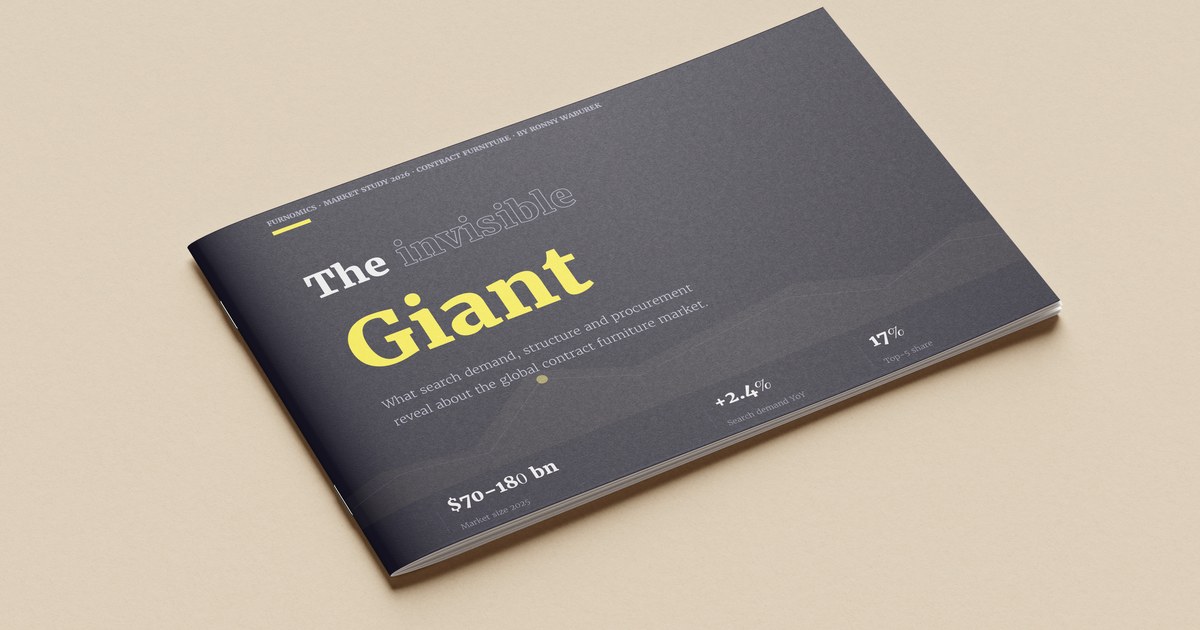
“The Invisible Giant – Contract Furniture Market Study 2026” examines the size, structure and development of the international contract furniture market across 28 pages. It combines international market estimates with furnomics’ own analysis of search demand and insights into the industry’s procurement structures.
The study is published in English and German. It is not available as a public download.
New subscribers to the free furnomics newsletter receive the full study personally by email once their sign-up is confirmed.
RELATED ARTICLES


The invisible giant
How big is the contract furniture market?

70 billion dollars. Or 180 billion. In between lie 110 billion dollars and a rather astonishing gap in knowledge. The international contract furniture market is a multi-billion-dollar business whose size nobody seems to know with any precision. furnomics has examined the figures – and found a few peculiarities of an industry that is larger than its digital presence would suggest.
Anyone wanting to know how big the global contract furniture market is needs one thing above all: a willingness to live with very different answers.
Global Market Insights puts the business at around 70 billion US dollars for 2025, Grand View Research at 78 billion. Fortune Business Insights arrives at 144 billion. Other institutes put the market as high as 180 billion dollars. A difference it would take rather a lot of office chairs to make up.
And yet all of them are supposedly looking at the same business.
The problem starts with the definition. What exactly counts as contract furniture? The desk in a law firm does, as do the armchairs in a hotel lobby, the furniture of a university and the fit-out of a hospital. Depending on which products and sales channels an institute includes, the market grows or shrinks by tens of billions.
The figures are therefore less contradictory than they first appear. They simply do not always describe the same thing.
Billions in sales, hardly any searches
It becomes even more striking once the proportions online come into view. There, the industry leads a decidedly modest existence.
For “office furniture”, Ahrefs reports an estimated global search volume of around 76,000 queries a month. The industry term “contract furniture” manages a mere 2,000. A ratio of 38 to one. That said, “office furniture” also covers searches from the private home-office segment, so the figures are not a direct comparison of commercial demand.
Contract furniture is not bought any less often for that. It is simply searched for differently: by application rather than by industry. Workplace terms, for instance, draw around 81,000 searches a month worldwide, 4.7 times as many as hospitality terms. And a contract often does not begin with a Google search in any case, but with a design, a tender or a conversation between specifier and manufacturer.
For while visibility, range and price often tip the balance in conventional furniture retail, the contract business plays by different rules. Architects and interior designers shape product selection and specifications. Dealers organise complex projects, manufacturers work with established partners. Who wins a contract is sometimes decided long before the first order is written.
For new suppliers, that can be a fairly high hurdle. Those who do not appear in the right networks may never make it onto the shortlist at all.
A multi-billion market with no single ruler
Conditions at the top of the market are unusual, too. Large international furniture groups shape the business, yet alongside them a wide range of other manufacturers and suppliers hold their own. For all its billions in sales, the contract furniture market is remarkably fragmented. According to Global Market Insights, the five largest suppliers – MillerKnoll, Haworth, Steelcase, HNI and Kimball – together held only around 17 per cent. That HNI has since acquired Kimball and Steelcase changes little.
That leaves room for specialists, regional manufacturers and companies that meet particular project requirements especially well. At the same time, the sheer number of players makes the market hard to survey. International scale is an advantage, but by no means a ticket to every contract.
And what comes next?
Most market forecasts expect annual growth rates of five to six per cent over the coming years. Digital search demand as analysed by furnomics, by contrast, recently rose by just 2.4 per cent year on year.
Above all, the comparison shows how little the economic development of this industry can be read from search data alone. Searches, after all, are not orders.
There is a caveat: the forecasts describe the global market, not every country or every segment. German office furniture manufacturers, for one, have been in a downturn for more than a year. Their sales came to EUR 2.2 billion in 2025, 8.8 per cent less than the year before, according to the industry association IBA. The first half of 2026 brought a further 5.6 per cent decline, with domestic business down as much as 8.5 per cent. For now, the industry is finding growth mainly in exports. The figures in detail are in the furnomics review of Orgatec 2026.
Understanding the contract furniture market therefore means looking more closely: at regional differences, procurement routes, decision-making structures, competition and the often underestimated power of specifiers.
The new furnomics study “The Invisible Giant” examines these connections, compares international market data and analyses where opportunities open up – and which hurdles manufacturers and dealers have to overcome.
For perhaps the greatest puzzle of this multi-billion market lies not in its actual size at all. But in how to gain access to it in the first place.
Contract furniture market study 2026
Get the full study
“The Invisible Giant – Contract Furniture Market Study 2026” examines the size, structure and development of the international contract furniture market across 28 pages. It combines international market estimates with furnomics’ own analysis of search demand and insights into the industry’s procurement structures.
The study is published in English and German. It is not available as a public download.
New subscribers to the free furnomics newsletter receive the full study personally by email once their sign-up is confirmed.